
1. Why you need this tool
Midway through a TypeScript project you will almost certainly hit these problems: async logic scattered across async/await, errors swallowed or degraded into unknown; dependency injection done by passing arguments by hand, with function signatures growing longer on every change; no structured control in concurrent scenarios, so resource cleanup depends on discipline; observability propped up with console.log until production makes it obvious that tracing is a blank page. These are not cases of one chunk of code being written badly — the engineering infrastructure is missing. Effect folds these capabilities into a single type-safe runtime, so you can write industrial-grade backend and full-stack applications in plain TypeScript.
2. In one sentence: what this project is
Effect is a production-grade application framework for TypeScript, positioned as "Spring + Arrow + Cats for Node.js". 15,251 GitHub stars, and four keywords for the core features: typed errors, dependency injection, structured concurrency, and unified Schema validation. V4 is currently at RC, with main under constant iteration.
3. A deep dive into the core features
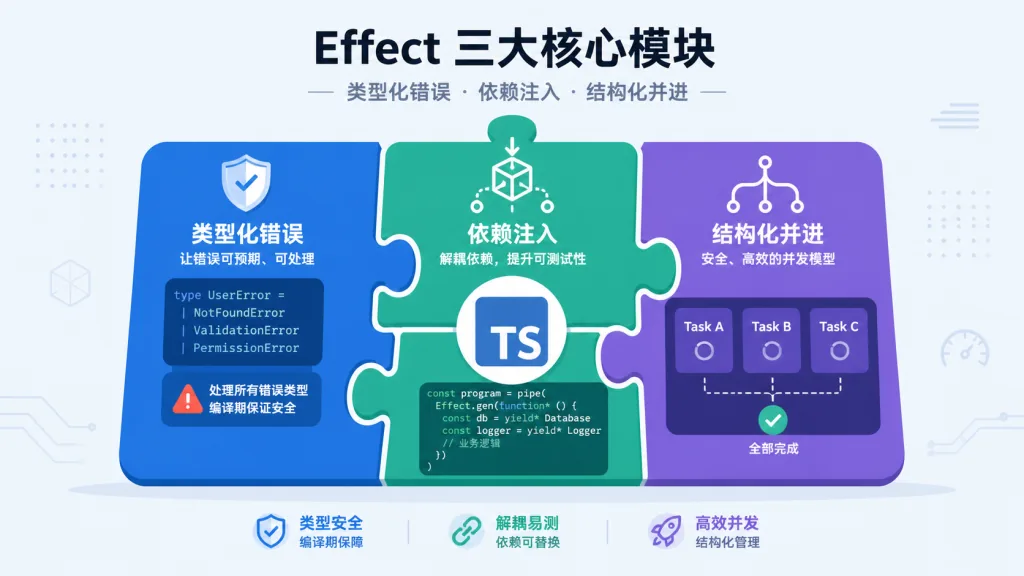
1. Typed errors
Traditional try/catch collapses everything thrown into Error, mixing business errors with program errors. Effect uses a three-parameter signature Effect<A, E, R> to declare failure types explicitly: the success value is A, the error type is E, the required dependency is R. The compiler forces you to handle every error branch, and you never need any as a fallback again.
2. Dependency injection (Layers)
Effect's Layer system is the most complete DI implementation in the TypeScript ecosystem. Database connections, HTTP clients and config services are all composed as Layers and injected at runtime via Effect.provide. Swap in a mock layer for tests; switch implementations for production without touching business code. It is more type-safe than hand-rolled factory functions or tsyringe, and dependency relationships are checked by the compiler.
3. Structured concurrency
Effect.all, Effect.forEach and Fiber provide interruptible, timeout-aware and cancellable concurrency primitives. When the parent scope exits, child fibers clean up their resources automatically; race execution, timeout control and rate limiting (@effect/workflow) are all first-class. The handle leaks and memory buildup that plague Node.js are systematically avoided under a structured concurrency model.
4. Unified Schema and ecosystem
@effect/schema uses a single definition to support runtime validation, serialization, JSON Schema generation and type inference at the same time. The surrounding ecosystem covers SQL (PostgreSQL/MySQL/SQLite/ClickHouse/D1), AI (OpenAI/Anthropic/OpenRouter), OpenTelemetry, React/Solid/Vue bindings and the Vitest toolchain — 30+ packages in one monorepo, covering 90% of backend scenarios.
4. Technical highlights and performance numbers
Effect V4 substantially rewrote its underlying data structures, making runtime performance 2–5x faster than V3 (official benchmarks); the concurrency scheduler uses an M:N coroutine model, so a single process can host tens of thousands of fibers. Paired with the Go rewrite of the TypeScript 7 compiler (@effect/tsgo), type-checking time drops by more than 10x compared with tsc. The project requires TypeScript 5.9+, Node.js 18+, and mandates strict mode — that baseline keeps type inference from being undercut at runtime.
5. Where it fits, and who it's for
Good for: building highly available backend services, medium-to-large projects that need fine-grained error handling and observability, AI agent workflows (first-party OpenAI/Anthropic adapters), multi-runtime deployment (Node/Bun/Deno/Cloudflare Workers/React Native). Not for: quick prototypes (the learning curve is steep), lightweight pure-frontend pages, teams with no TypeScript experience at all.

6. Comparison with alternatives
| Dimension | Effect | fp-ts | RxJS | NestJS |
|---|---|---|---|---|
| Typed errors | ✅ compile-time checks | ❌ | ❌ | ❌ |
| Dependency injection | ✅ Layer system | ❌ | ❌ | ✅ decorators |
| Structured concurrency | ✅ Fiber | ❌ | ⚠️ subscription model | ⚠️ |
| Schema validation | ✅ unified | ❌ | ❌ | ⚠️ class-validator |
| Learning curve | Steep | Steep | Medium | Medium |
Effect's differentiator is "using the type system to unify errors, dependencies, concurrency and Schema"; every other library covers just one of those dimensions.
7. Getting started fast
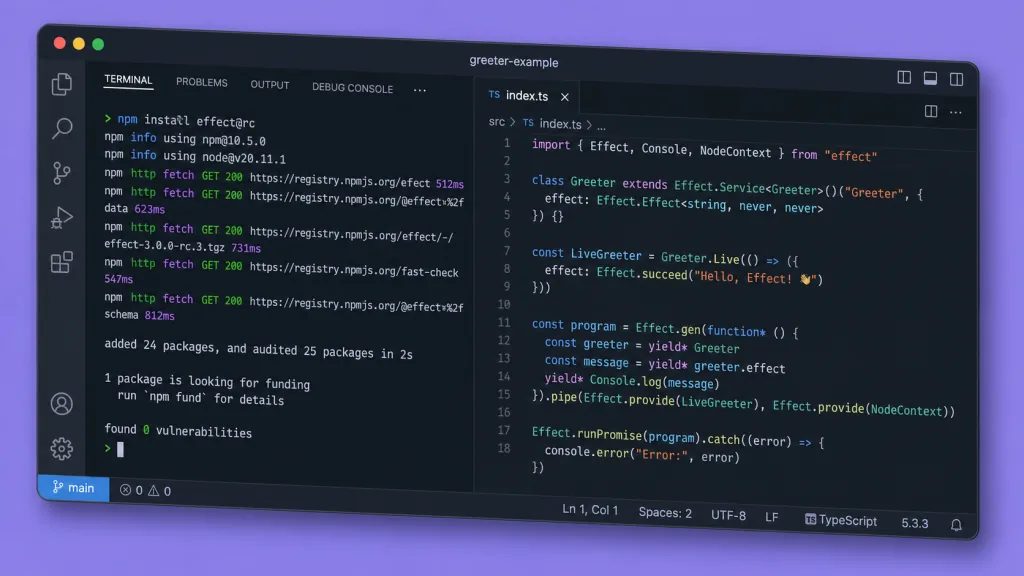
npm install effect@rc
Make sure tsconfig.json enables "strict": true and that TypeScript is on 5.9+. A minimal example — a Hello with typed errors and dependency injection:
import { Effect, Layer } from "effect"

class Greeter extends Effect.Service<Greeter>()("Greeter", {
  succeed: { greet: (name: string) => `Hello, ${name}` }
}) {}

const program = Effect.gen(function* () {
  const greeter = yield* Greeter
  return greeter.greet("Effect")
})

Effect.runPromise(program.pipe(Effect.provide(Greeter.Default)))
  .then(console.log)
Next steps: start from @effect/platform-node + @effect/sql-pg and build a CRUD service, then hook up tracing in one step with @effect/opentelemetry.
8. Summary and what to do next
Effect solves TypeScript's engineering hard parts — errors, dependencies, concurrency, observability — in one pass, at the cost of a higher entry barrier. If you already write production services in TypeScript and keep getting burned by the pain points above, V4 RC is worth a week of evaluation.
- Repo: https://github.com/Effect-TS/effect
- Docs: https://effect.website
- Community: Discord (https://discord.gg/effect-ts)
One-line pitch: the strongest infrastructure for writing backends in TypeScript. Full stop.