1. Why you need this
Anyone doing quant research knows the pain: general time-series models fall apart the moment they meet a financial candlestick. More than 60% of an A-share one-minute bar is noise, crypto swings around the clock, and a vanilla Transformer regressing directly on continuous OHLCV values (open/high/low/close/volume) is like carrying water in a colander — it can't hold the discrete structure, let alone learn the "grammar" of the market.
The more practical problem: open source has long lacked a pretrained foundation model built specifically for financial candlesticks. Want to fine-tune? You chew through a general GPT-style model. Want a specialized one? You hit paid APIs and closed weights. Then Kronos showed up — a foundation model that teaches candlesticks to "speak", packing data from 45 global exchanges into 499M parameters and open-sourcing three weight sizes on day one.
2. What it is, in one sentence
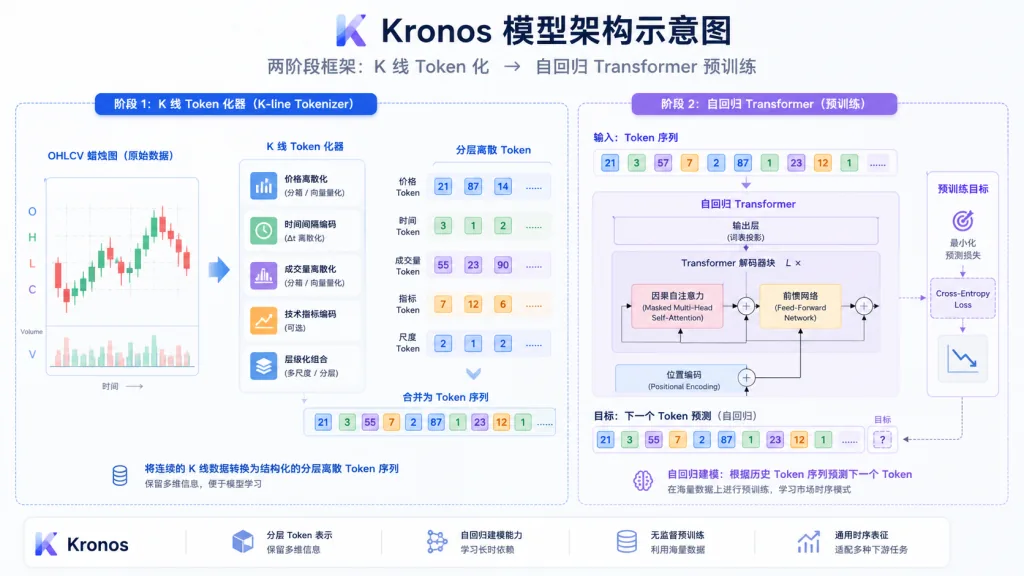
Kronos is the first open-source foundation model for financial candlesticks, built around a "language modeling for K-lines" approach. It quantizes continuous OHLCV sequences into hierarchical discrete tokens, then feeds them to an autoregressive Transformer for large-scale pretraining. As of November 2025 it has passed 36.8K GitHub stars, was accepted to AAAI 2026, and the paper is on arXiv (2508.02739).
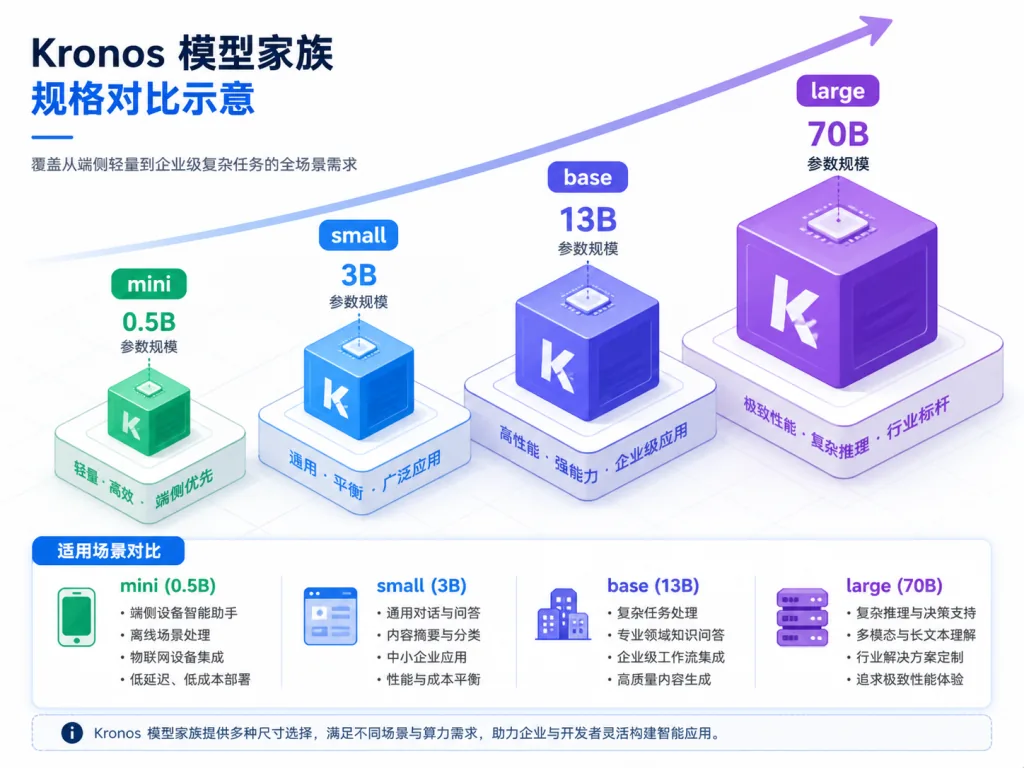
Four keywords: finance-specific, tokenized pretraining, unified multi-task, fully open weights. Kronos-mini (4.1M), Kronos-small (24.7M) and Kronos-base (102.3M) are already released; the Large version (499.2M) is not yet public.
3. Core features in depth
1. A two-stage candlestick tokenization pipeline
Kronos's core idea is to treat candlesticks as language. In stage one, a dedicated Kronos-Tokenizer quantizes continuous multi-dimensional OHLCV data into hierarchical discrete tokens, preserving the semantic levels of fields like open and close. In stage two, an autoregressive Transformer pretrains on those tokens and produces a unified representation. Compared with direct numeric regression, this is far more noise-resistant and much easier to transfer to downstream tasks such as classification and generation.
2. A unified multi-task interface
Kronos folds price forecasting, volatility modeling and signal generation into one pretrained backbone, so you no longer hand-build a head per task. Swap the Tokenizer and Predictor pairing and you can scale anywhere from 4.1M to 499.2M — the mini version runs experiments on a single laptop GPU.
3. Batch parallel prediction
The predict_batch API forecasts many assets in parallel, with all series sharing one set of hyperparameters (temperature T, top-p sampling, sample count). On multi-GPU machines throughput goes up 3–5x, which makes it a natural fit for factor scanning and bulk scoring ahead of portfolio backtests.
4. A complete fine-tuning and backtest pipeline
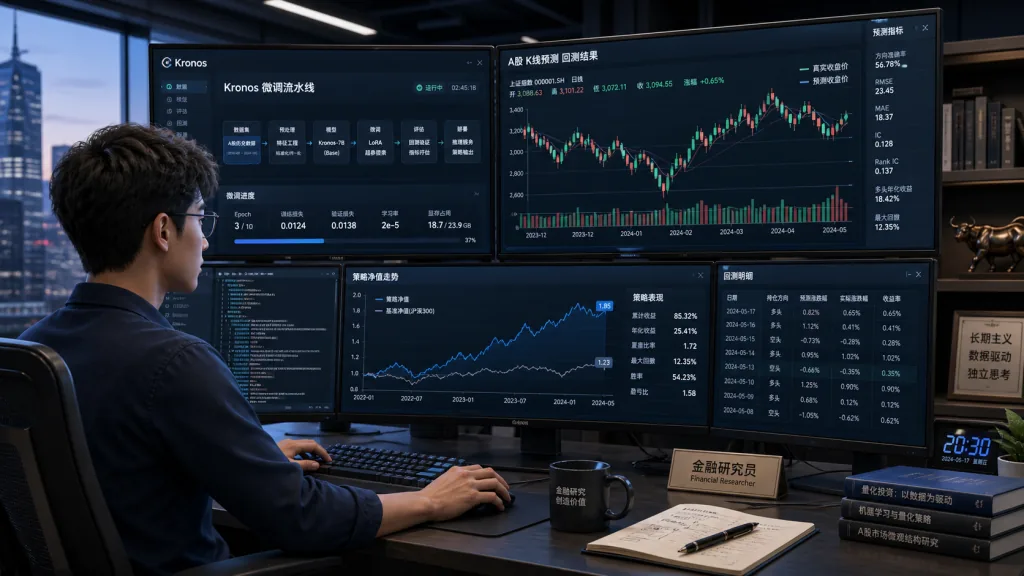
The project ships a Qlib-based fine-tuning example covering A-share daily data preprocessing, two-stage fine-tuning of Tokenizer and Predictor, and a simple Top-K backtest. The maintainers are explicit that this is a demo, not a production strategy, but the whole chain is wired up — researchers can copy the pattern onto their own datasets.
4. Technical highlights and numbers
Kronos trains on cross-market candlesticks from 45 global exchanges — currently the largest publicly available pretraining corpus of its kind. The architecture is a decoder-only Transformer plus hierarchical tokenization, and it clearly beats general time-series baselines such as TimeGPT and Lag-Llama on multiple financial forecasting benchmarks.
On ecosystem compatibility: all weights are hosted on the Hugging Face Hub (the NeoQuasar org) and load with a single from_pretrained call. Multi-GPU fine-tuning works through PyTorch + torchrun, and everything plays nicely with Qlib, pandas and matplotlib. The paper was accepted to AAAI 2026, the community is active, and the latest update landed in November 2025.
5. Who it's for
Quant researchers: if you need to validate candlestick-based factors fast without training a Transformer from scratch, Kronos-mini at 4.1M parameters fine-tunes on a single GPU.
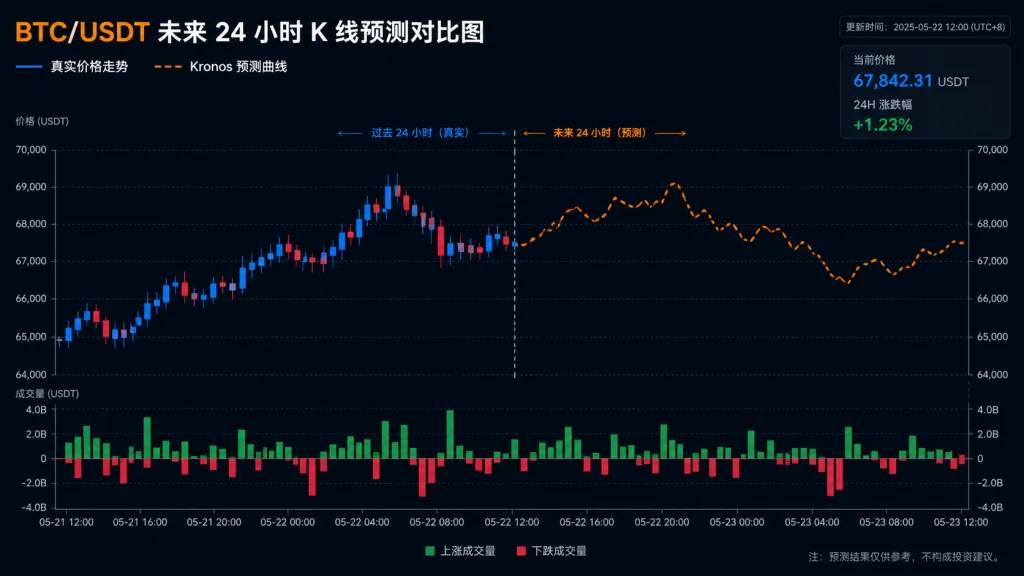
Crypto and FX traders: 24-hour pairs like BTC/USDT are extremely noise-sensitive; Kronos's live demo shows 24-hour-ahead forecasts that can serve as an auxiliary signal source.
Academic and institutional researchers: teams reproducing the AAAI 2026 paper, running comparisons, or migrating to private data can fine-tune straight from the open weights.
Who it's not for: retail traders chasing "plug and play, steady annualized returns" — Kronos is a research backbone, not a risk-managed strategy product.
6. Comparison
| Project | Data scope | Open source | Finance-specific | Smallest model |
|---|---|---|---|---|
| Kronos | Candlesticks from 45 exchanges | All three sizes open | ✅ | 4.1M |
| TimeGPT-1 | General time series | Closed API | ❌ | Undisclosed |
| Lag-Llama | Univariate time series | Open source | ❌ | General |
| Chronos | General time series | Open source | ❌ | 8M |
Kronos wins on all three axes at once — finance-specific candlestick modeling, fully open source, multiple sizes — and its pretraining data dwarfs comparable open projects.
7. Getting started fast
Setup takes three steps: Python 3.10+, pip install -r requirements.txt, and a CSV with open/high/low/close columns.
Minimal working example (forecast in 4 steps):
from model import Kronos, KronosTokenizer, KronosPredictor
import pandas as pd

tokenizer = KronosTokenizer.from_pretrained("NeoQuasar/Kronos-Tokenizer-base")
model = Kronos.from_pretrained("NeoQuasar/Kronos-mini")
predictor = KronosPredictor(model, tokenizer, max_context=2048, device="cuda:0")

df = pd.read_csv("data.csv")
pred_df = predictor.predict(df=df, x_timestamp=df['timestamps'][:400],
                           y_timestamp=df['timestamps'][400:520], pred_len=120)
What to do next: experiment with Kronos-mini first, confirm your data format is right, then move to Kronos-base for accuracy. For A-share factor research, reuse the Qlib pipeline under finetune/.
8. Takeaways
Kronos's real contribution is turning financial candlesticks into a language a foundation model can learn: hierarchical tokenization handles the noise, an autoregressive Transformer unifies multiple tasks, and open weights across sizes handle deployment. For any quant team that wants to skip the "build a model from scratch" phase, this is the financial foundation model worth bookmarking from 2025.
Suggested path: run the demo's BTC/USDT 24-hour forecast first, fine-tune the mini version on your own data to validate, then upgrade to base or apply for large access as needed.
Links:
- GitHub: https://github.com/shiyu-coder/Kronos
- Hugging Face models: https://huggingface.co/NeoQuasar
- Live demo: https://shiyu-coder.github.io/Kronos-demo/
- Paper: https://arxiv.org/abs/2508.02739
One-line pitch: Kronos is WordPiece for candlesticks — financial time-series modeling finally has an open backbone that is genuinely fine-tunable, commercially usable and reproducible.