1. Opening: how many traps does one paper hide?
PhD student A is three chapters in when the advisor sends it back with "the literature review isn't deep enough." Early-career scholar B submits to IEEE and a reviewer points out that "three of your references are fabricated." Grad student C wraps up R1, starts prepping R2, and finds that what the reviewers care about this round has nothing to do with the last one. The shared pain: academic writing was never a solo job, yet every collaboration step keeps dropping the ball — missed searches, fabricated references, quotes that don't support the argument, misread review comments, revisions with nowhere to start. These traps don't disappear when you switch to a stronger model. The root cause is process.
2. What it is: Academic Research Skills
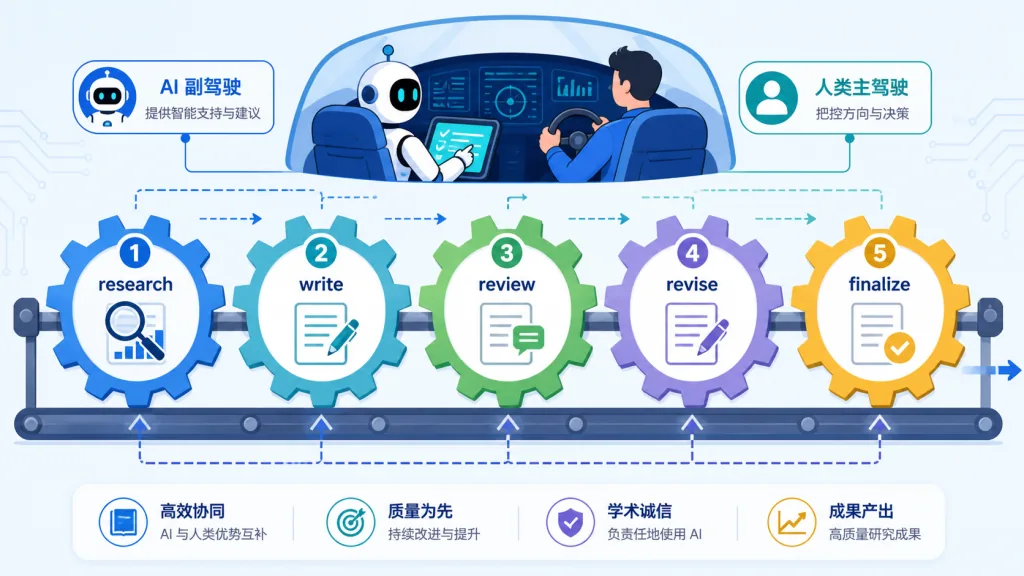
Imbad0202/academic-research-skills on GitHub (42k+ stars) is a set of academic research skills built for Claude Code. It splits the paper pipeline into five stages: research → write → review → revise → finalize. The current version is v3.19.0, after 19 major iterations. Core labels: human-in-the-loop, AI co-pilot, citation trust chain, cross-model blind review. The project describes itself in one line — "AI is the co-pilot, not the pilot." The co-pilot handles the dirty work: hunting down literature, checking citations, verifying data, auditing logic. You stay in the driver's seat.
3. Core features in depth
1. Deep Research: a 13-agent reconnaissance unit for research
Deep Research is not "one model plus one prompt." It splits out 13 agents across eight modes: Socratic guidance, PRISMA systematic review, intent recognition, dialogue health monitoring, Semantic Scholar API validation and more. The Socratic mode deserves the most attention: v3.0 added an intent-recognition layer that separates "exploratory conversation" from "goal-directed task." In exploratory mode it forbids the premature wrap-up of "want me to summarize this for you?" and raises the turn cap to 60. It also quietly ships a Dialogue Health Indicator that self-checks every five rounds — persistent sycophancy, conflict avoidance, premature convergence — and injects challenging questions when it finds a problem. That check stays invisible to the user so it can't be gamed.
2. Academic Paper: a writing line from outline to APA 7 PDF
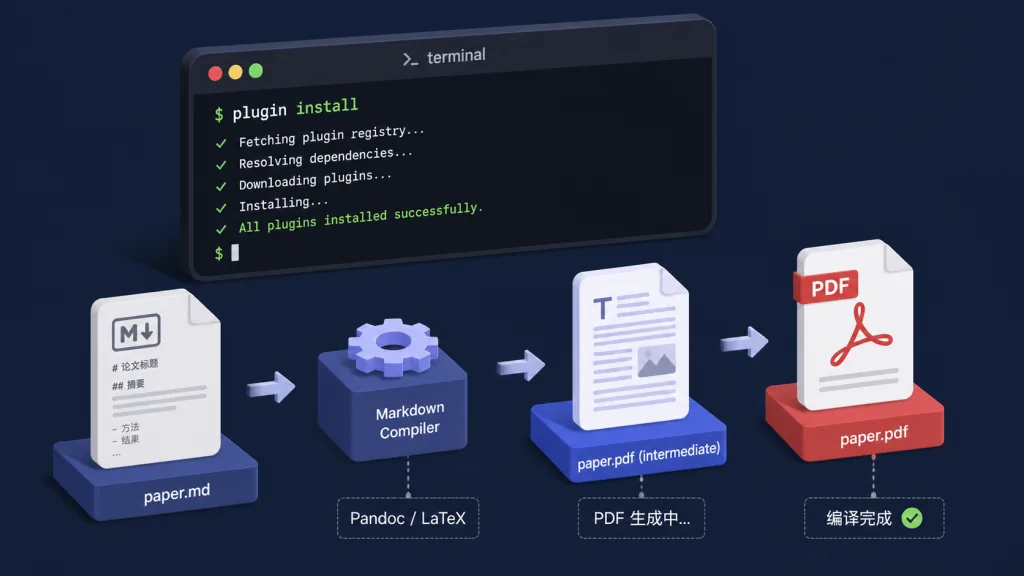
A writing pipeline strung together from 12 agents, covering eleven modes: Style Calibration (learning your tone from past papers), Writing Quality Check (catching phrasing that reads machine-written at a glance), LaTeX hardening, visualization, revision coaching, citation conversion, leak-prevention protocol, and VLM figure validation. Citations default to APA 7.0, with Chicago, MLA, IEEE and Vancouver also supported. Structures cover six paper types: IMRaD, topical literature review, theoretical analysis, case study, policy brief and conference paper. Output goes Pandoc → DOCX and Tectonic → LaTeX/PDF, and you can also get plain Markdown without either dependency.
3. Academic Paper Reviewer: seven reviewers plus a devil's advocate
full mode uses a fixed lineup: Journal-Fit Reviewer + 3 dynamic reviewers + 1 Devil's Advocate, scoring quality from 0 to 100. The decision mapping is hard-coded: ≥80 Accept, 65–79 Minor Revision, 50–64 Major Revision, <50 Reject. The key point: the DA is not a formality. It ships a Concession Threshold Protocol — every rebuttal is first scored 1–5, and the DA may only concede at ≥4 (the rebuttal hits the core attack and brings evidence); at ≤3 it holds the original attack. Consecutive-concession detection, concession-rate tracking and Frame-lock detection are all on the board. This came directly out of v3.0: the author noticed that four rounds of DA debate stayed on "attack the argument, not the premise" and never once questioned whether the question under discussion was the right one.

4. Academic Pipeline: a 10-stage orchestrator with two hard gates
The whole academic pipeline is a 10-stage orchestrator, and each stage needs user confirmation before the next one starts. The harshest part is the two integrity gates at Stage 2.5 and Stage 4.5 — a pre-writing health check (which caught 15 fabricated references plus 3 statistical errors in the Showcase) and a pre-final check that confirms zero regressions. Each gate runs a 7-mode failure checklist: implementation bugs, hallucinated results, shortcut dependencies, repackaging a bug as an Insight, methodological fabrication, Frame-lock, and citation hallucination. Those seven failure modes are cited directly from Lu et al. (2026, Nature 651:914–919), "The AI Scientist," as the design basis.
5. Citation trust chain: three-layer locators plus Claim Audit
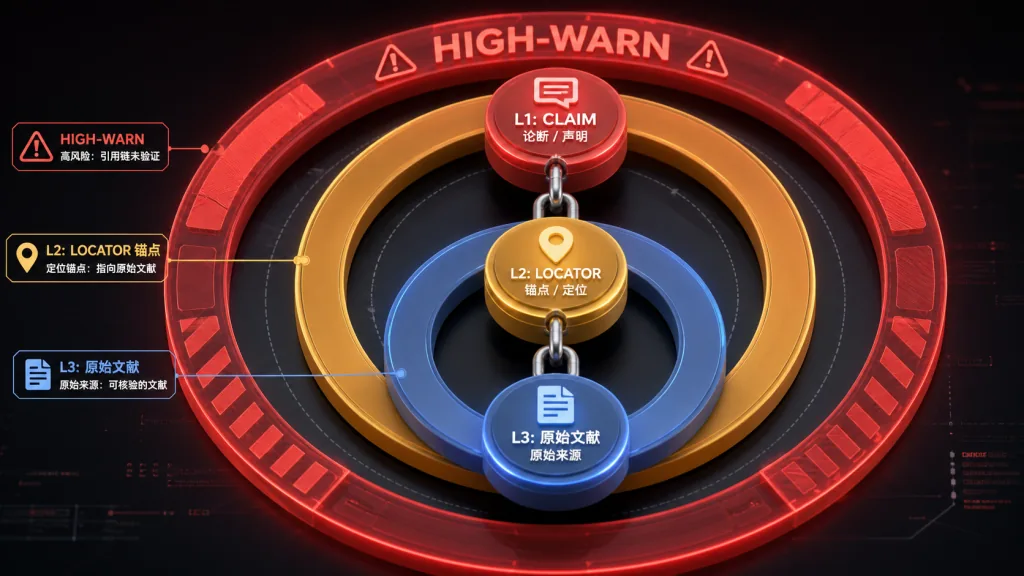
The Zhao et al. audit of May 2026 — 2.5M papers, 111M citations — triggered the v3.7 rewrite: an estimated 146,000 hallucinated citations that year, with "a real citation supporting the wrong claim" named as an open challenge. v3.7.x adds three things: traceable reference frontmatter (trust-chain frontmatter), three-layer locator anchors (locator infrastructure), and a Claim Audit switch (ARS_CLAIM_AUDIT=1). Turn the switch on and every citation pulls the original text for verification, deciding whether the claim is actually supported. The five HIGH-WARN classes that fail the check (claim-not-supported, negative-constraint-violation, fabricated-reference, anchorless, constraint-violation-uncited) are forcibly rejected by the formatter.
4. Technical highlights and performance data
- 10-stage pipeline, 39 agents in total: 4 core skills (Deep Research / Paper / Reviewer / Pipeline), each with its own agent team.
- Transparent cost: a 15,000-word paper through the full flow costs about $4–6, and
docs/PERFORMANCE.mdlists the token budget per mode. - Cross-model blind review: under the
ARS_CROSS_MODELswitch, the primary/orchestrator/primary three-stage blind path follows the standard[CROSS-MODEL-HANDOFF v1]protocol, backed by a Python syntax parser atscripts/cross_model_handoff.py— no more prose-style "please comply" constraints. - Cross-language intent recognition in Socratic mode: intent is semantic, not keyword-based, so Socratic guidance works in any language; the generic Trigger Keywords currently cover English and Traditional Chinese and can be extended by hand.
- Data Access Level and Task Type annotations: every skill declares
data_access_level(raw / redacted / verified_only) andtask_type(open-ended / outcome-gradable), enforced bycheck_data_access_level.py. The pattern comes from Anthropic's 2026 automated-w2s-researcher practice. - Ecosystem: supports Claude Code, Claude Science (direct GitHub import), Pi and Codex CLI; multilingual READMEs cover Simplified Chinese, Traditional Chinese, Japanese and Korean.
5. Who it's for
- Scenario 1: a PhD or master's student writing their first English paper alone: Socratic mode breaks the chapter structure down, Plan mode builds the outline, Style Calibration learns your tone, and the citation trust chain backstops hallucinations.
- Scenario 2: an early-career scholar submitting to IEEE/Springer/Elsevier: Journal-Fit Reviewer picks the venue, the DA guards against frame-lock, Stage 4.5 runs the integrity gate, and Post-Publication Audit catches what's left (the Showcase found 21/68 problems that all three gate rounds had missed).
- Scenario 3: a cross-disciplinary team writing a review together: a systematic review with PRISMA double validation from 13 agents, cross-model blind review to avoid false positives from a shared cognitive frame, and a Material Passport tracking the evidence chain behind every claim.
- Not for: people who won't do the human gatekeeping (human-in-the-loop is the core premise of the whole design), people who want ARS to run experiments (use the companion experiment-agent; ARS doesn't execute experiments), and people who want byte-reproducible LLM output (the docs state plainly that "LLM output cannot be reproduced byte for byte").

6. Comparison
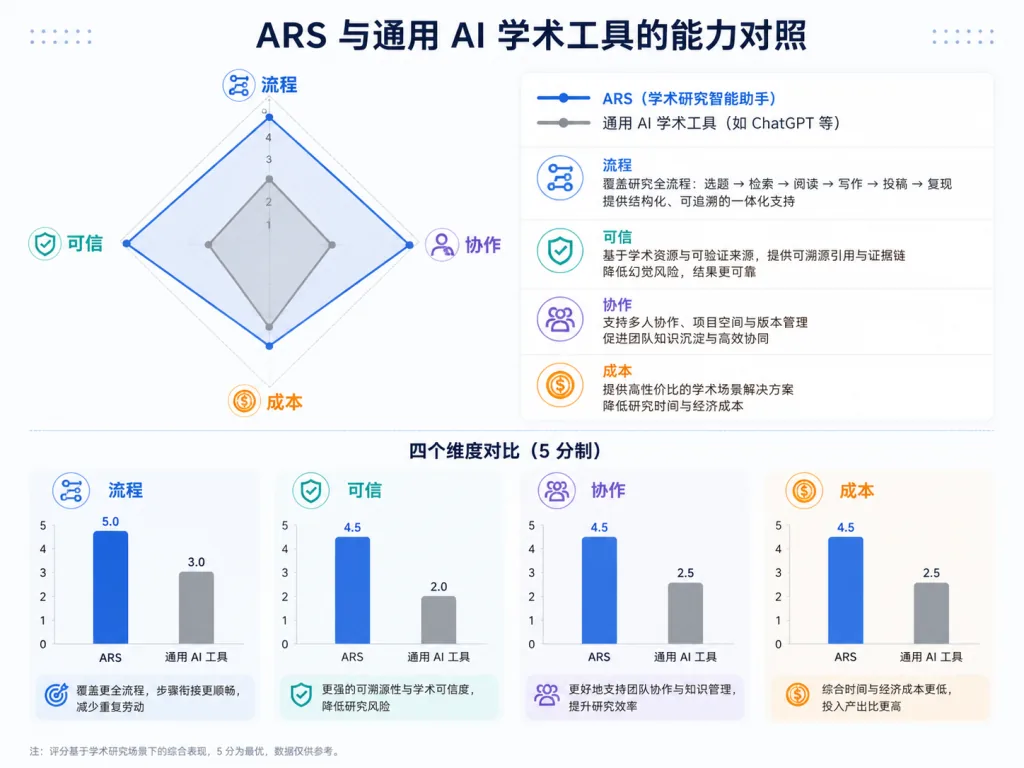
| Dimension | academic-research-skills (ARS) | General AI research tools like Elicit / Consensus / Scite | Calling ChatGPT/Claude directly |
|---|---|---|---|
| Coverage | Full loop: research → write → review → revise → finalize | Mostly stops at literature search/Q&A | Point capabilities; you wire the flow yourself |
| Citation trust | Three-layer locators + Claim Audit + trust-chain frontmatter | Most don't validate at claim level | Prone to "real citation, wrong claim" |
| Review mechanics | 7 agents, multiple perspectives + DA + 0–100 rubric + concession threshold | Usually a single-perspective score | No rubric framework |
| Human-in-the-Loop | Mandatory confirmation per stage + two hard gates | Mostly auto-passes | Entirely up to the user |
| Cost/control | ~$4–6 for 15,000 words, open source | Subscription, closed source | Per-token API cost, stack not under your control |
In one line: ARS makes process, trust and collaboration first-class citizens; general tools leave all three to the user.
7. Getting started
Fastest path (v3.7.0+):
/plugin marketplace add Imbad0202/academic-research-skills
/plugin install academic-research-skills
Setup: install Claude Code and export ANTHROPIC_API_KEY; optionally add Pandoc (DOCX export) + Tectonic + Source Han Serif TC (APA 7.0 PDF).
Minimal working example:
Open Claude Code, type /ars-plan and describe the paper you're writing; ARS walks you through the chapter structure in a Socratic dialogue. If you only want one capability, type /ars-lit-review "your topic".
Advanced: To use it in Claude Science, import straight from the GitHub URL (v3.14.0+ required); the import carries only the ARS methodology, so slash commands and hooks don't migrate. To run experiments, pair it with the experiment-agent repo. For cross-model blind review, set ARS_CROSS_MODEL=1; for Claim Audit, set ARS_CLAIM_AUDIT=1. All six install methods are in docs/SETUP.md.
8. Takeaways and next steps
The core value of Academic Research Skills in one line: treat AI as the co-pilot and process as the pilot. It won't write the paper for you, but it takes the dirty work of writing one — literature search, citation checking, logical consistency, statistical rigor, reviewer pushback — and folds it into a 10-stage pipeline with two hard gates. That leaves you free for the parts only humans do well: defining the problem, choosing the method, interpreting the data, and writing the sentence that follows "I argue that."
Suggestions: start with /ars-plan or /ars-lit-review to learn the flow; before submitting, make sure the Stage 4.5 integrity report passes and Post-Publication Audit has run; for citation-heavy work, turn on ARS_CLAIM_AUDIT=1.
Project: https://github.com/Imbad0202/academic-research-skills; docs entry point https://docs.claude.com/en/docs/claude-code/setup; companion experiment repo https://github.com/Imbad0202/experiment-agent. If you're tired of fighting papers alone, install it into Claude Code and let the co-pilot take the wheel.