
1. Opening: the pain point almost every ops engineer has hit
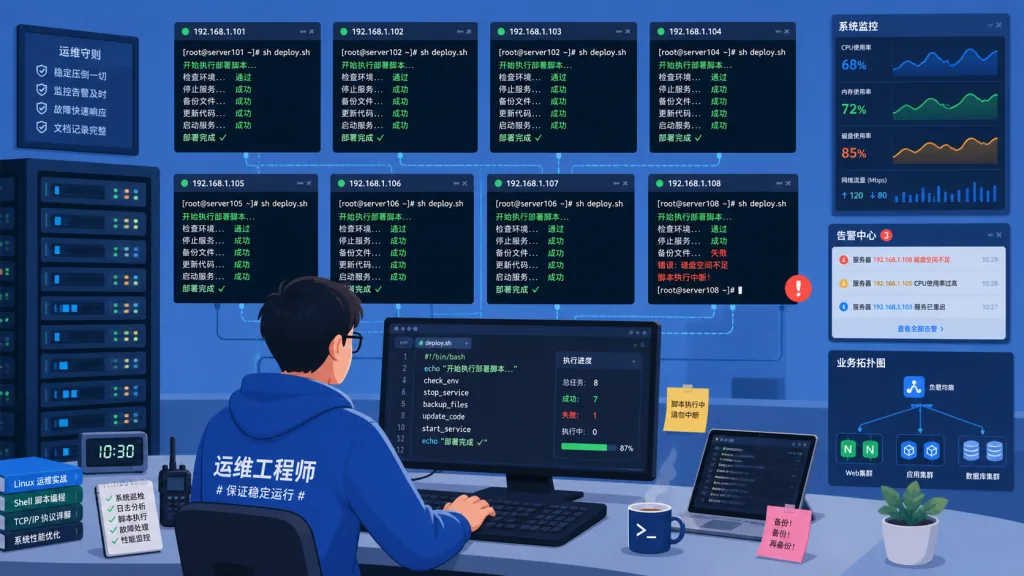
At 3 a.m. a database fails over, and the on-call engineer runs scripts by hand across 30 servers, one at a time. A new hire's first week is spent asking you five times which machine to log into to restart a service, which command to run, and in what order. That "running everything by hand" pain is something nearly every team has lived through.
Rundeck exists to solve exactly this. It pulls operational work scattered across SSH terminals, documents and group chats into a single platform where workflows can be reused, audited and authorized.
2. What it is, in one line
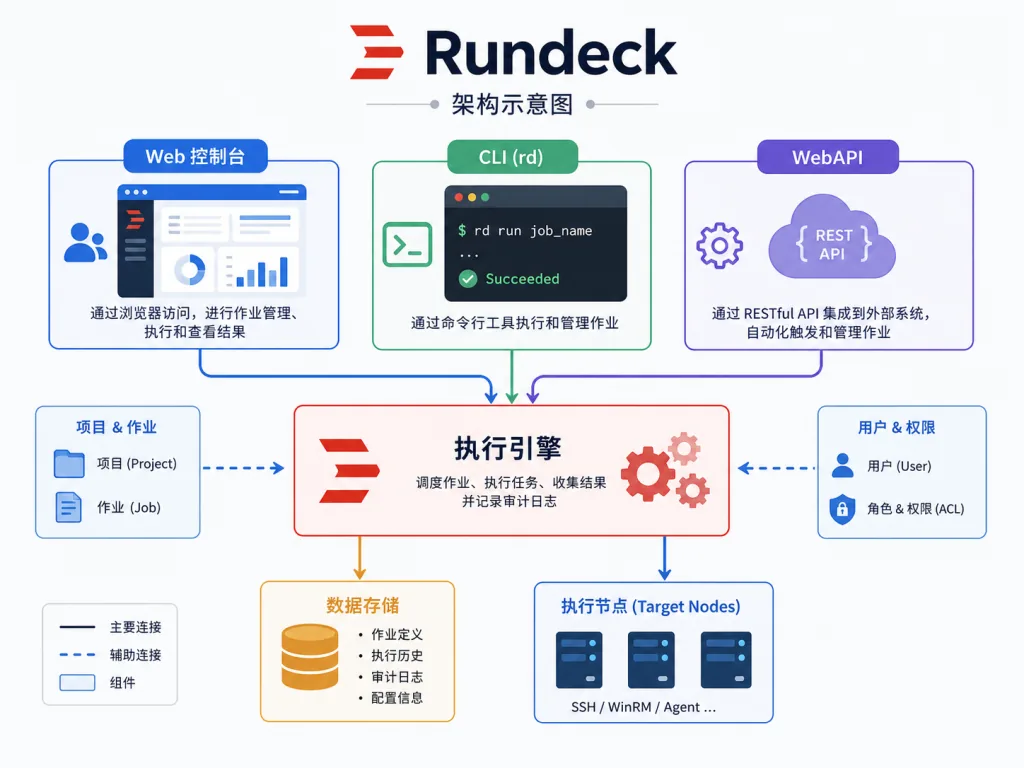
Rundeck is an open-source runbook automation service maintained by PagerDuty, with 6.2K+ stars on GitHub. It offers three entry points — a web console, a CLI and a WebAPI — and lets you orchestrate existing scripts, tools and services into standardized "jobs" that run on a chosen set of nodes with one click.
The core features boil down to four keywords: self-service (non-ops staff can trigger operations safely), node orchestration (run the same flow across many machines in bulk), access governance (fine-grained ACLs over who can run what), and multiple entry points (web, CLI and API all work).
3. A deep dive into the core features
1. Jobs and workflows: turn scripts into reusable jobs
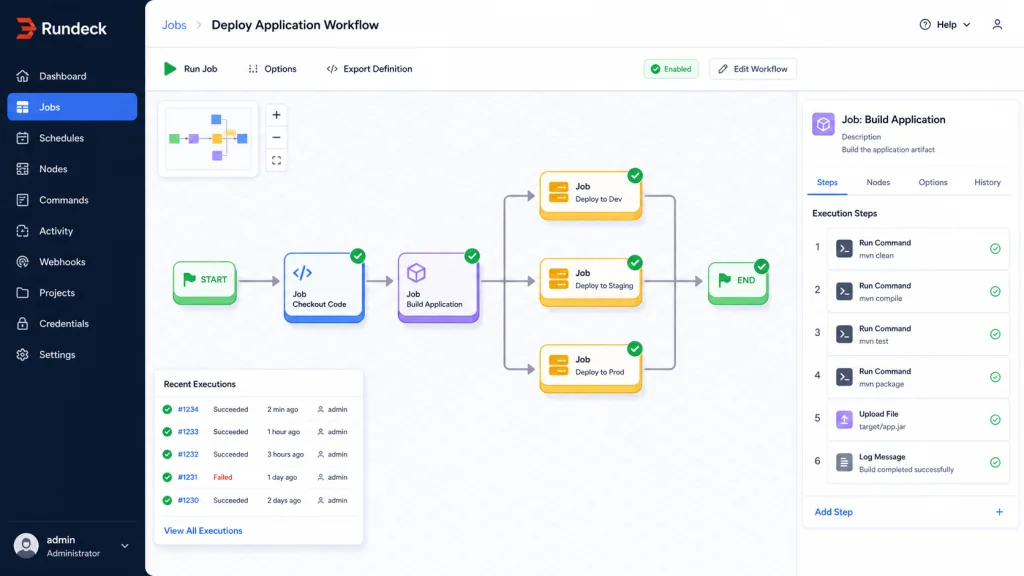
Rundeck's core abstraction is the "job". Wrap a Shell / PowerShell / Python script into a job, define parameters, nodes and execution order, and you have a workflow you can call over and over. Workflows also support error-handling strategies — continue, pause or roll back when a step fails — all configured in the UI, with no glue code to write.
2. Node sources: pluggable and flexible
Rundeck doesn't lock you to one source of nodes. It natively supports SSH, WinRM, Ansible Inventory, AWS EC2, Kubernetes and more. Cloud instances, physical machines in your own data center, and pods on a container platform can all join the same execution plane and be scheduled together.
3. ACLs and key storage: security done properly
Rundeck provides project-scoped fine-grained access control, plus Key Storage for sensitive material such as SSH private keys and API tokens. An ops lead can open something like "restart Tomcat" to developers while restricting them to their own test environments and weekday hours — self-service without giving up the security boundary.
4. Plugin ecosystem: Ansible, Git, K8s and more
Rundeck's plugin catalog is generous: official or community plugins exist for Ansible, Chef, Git, Jira, Slack and Kubernetes. You can treat Rundeck as the control deck for automated operations, wiring your existing toolchain together without tearing anything down.
4. Technical highlights and performance numbers
Rundeck's core is built with Groovy on the Grails framework, ships as a .war package, and runs on Java 11 or newer. The build toolchain is Gradle and produces four deliverables — WAR, Deb, RPM and Docker image — so deployment covers physical machines, VMs, containers and Kubernetes.
On the frontend, the project builds its UI component library (ui-trellis) with Node.js 18, previews components with Storybook, and runs unit tests with Jest. The architecture has been through many version evolutions and its stability is proven across a large number of production environments.
On ecosystem fit, Rundeck exposes a complete WebAPI that external systems can call directly, and it plugs into ChatOps and CI/CD pipelines as a trigger or executor for automated operations.
5. Where it fits, and who it fits
Scenario 1: bulk operations — database backups, service restarts, log cleanup, patch distribution, anything that repeats across many nodes, all scheduled through Rundeck.
Scenario 2: a secure, compliant self-service portal — let dev, QA and product trigger restricted operations from a web page with one click, without requesting temporary permissions.
Scenario 3: incident response automation — connect PagerDuty or your alerting system and turn alert-driven remediation into fixed jobs, cutting MTTR.
Good for: SREs, ops platform owners, DevOps engineers, and any technical manager who wants the team to "walk less and break less". Not for: individual developers who just want to run a one-off script (plain Shell is lighter).
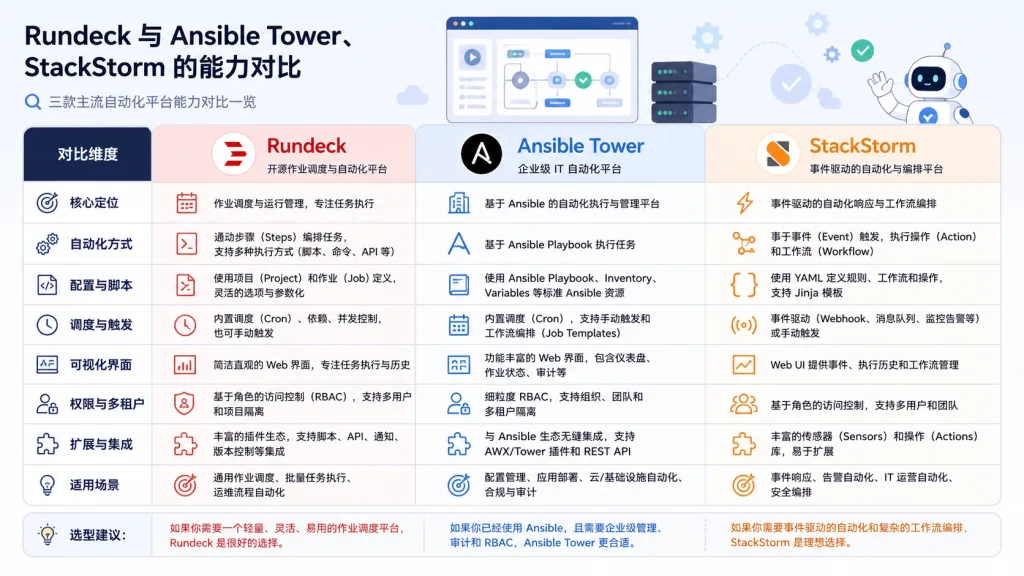
6. Comparison with alternatives
| Dimension | Rundeck | Ansible Tower | StackStorm |
|---|---|---|---|
| Deployment | Open source / commercial | Open source / commercial | Open source |
| Core focus | Runbook automation | Config management + execution | Event-driven orchestration |
| Self-service portal | Built-in web console | Requires custom development | Requires custom development |
| Node source coverage | Multi-cloud + K8s + traditional | Mostly Ansible Inventory | Mainly via integrations |
| Learning curve | Moderate | Low (if you know Ansible) | Steeper |
The case for Rundeck is direct: it genuinely makes operations self-serviceable for non-ops staff, the web console is mature, the permission model is clear, and you don't need to build your own wheel.
7. How to get started fast
Requirements: Java 11+, Node.js 18 (only needed for building from source; the official Docker image bundles it).
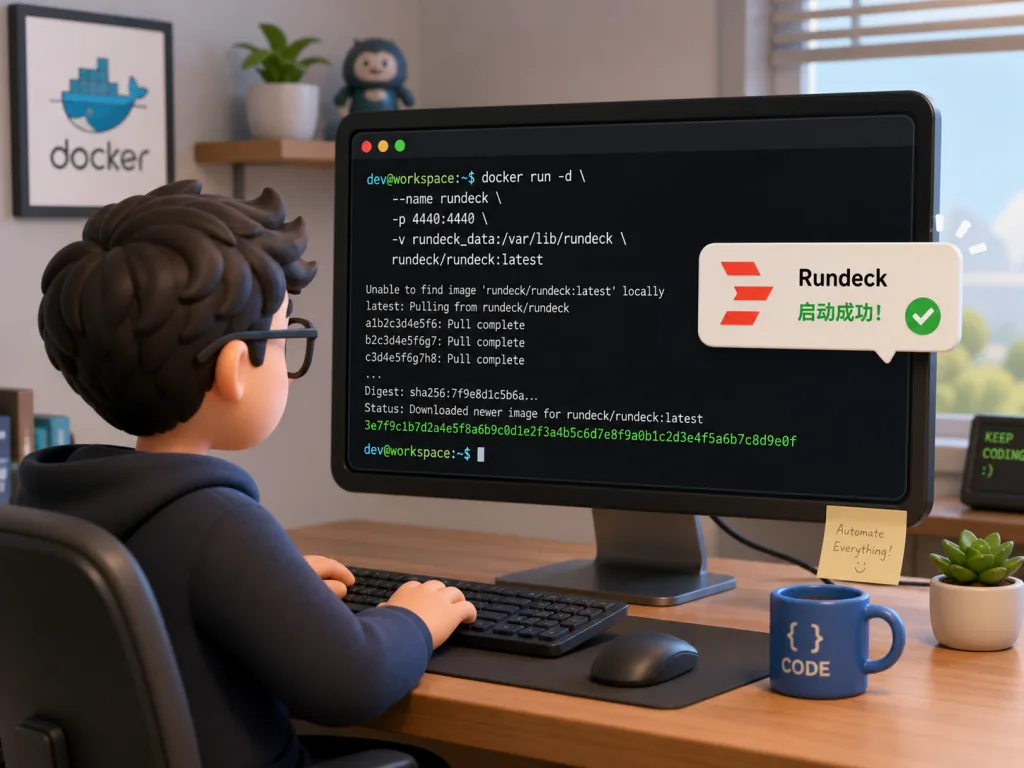
Option 1: quick start with Docker
docker run -d --name rundeck -p 4440:4440 rundeck/rundeck:SNAPSHOT
Open http://localhost:4440 in a browser and sign in with the default admin/admin.
Option 2: deploy the WAR package
java -jar rundeck-X.Y.war
Option 3: build from source
git clone https://github.com/rundeck/rundeck.git
cd rundeck
./gradlew build
The build output lands in rundeckapp/build/libs/rundeck-X.Y.war.
Minimal working example: after signing in, create a project, configure a node source (start with local SSH), write the simplest job that runs echo "hello rundeck", and schedule it once — the whole flow takes five minutes.
8. Takeaways and next steps
Rundeck's core value is taking ops processes from "memorized by people, passed around in group chats, looked up in docs" to "schedulable, auditable, authorizable". It doesn't invade Ansible's config-management territory and doesn't replace CI tools. It fills the long-neglected slot of the ops self-service portal.
If your team is bigger than five people, your operations have repeating patterns, and you want to unlock self-service, Rundeck is excellent value. Start with the Docker image, land your first job in a low-risk scenario (bulk log cleanup in a test environment, say), and expand toward production once it's proven.
- GitHub: https://github.com/rundeck/rundeck
- Website: https://www.rundeck.com
- Docs: https://docs.rundeck.com/docs
The one-line pitch: Rundeck is the shortest path from scattered scripts to standardized jobs for an ops team.