
Choosing a title (pick 1 of 3)
Backtests look spectacular, live trading bleeds money? Abu's quant system might save you
One config line between backtest and live trading: hands-on with Abu's full-chain quant framework
Without a quant system of your own, you're probably rebuilding the same wheel
1. The pain point every quant hobbyist has hit
What's the most soul-crushing moment in quant trading? You write the strategy, the backtest looks beautiful, you go live — and then: the market data feed drops, slippage eats all the profit, risk rules get bypassed, and the strategy has been running for a week with nobody able to tell you where it's actually losing money.
What stings more is that existing quant frameworks are either too heavy — just understanding the configuration is a chore — or too light: you get a backtest engine and have to build live trading, integration and risk control yourself. An open-source quant platform that covers the entire chain — data collection, strategy research, backtest validation, live trading, risk monitoring — is close to a necessity for anyone doing quant.
That's exactly what Abu is aimed at.

2. In one line: what this project is
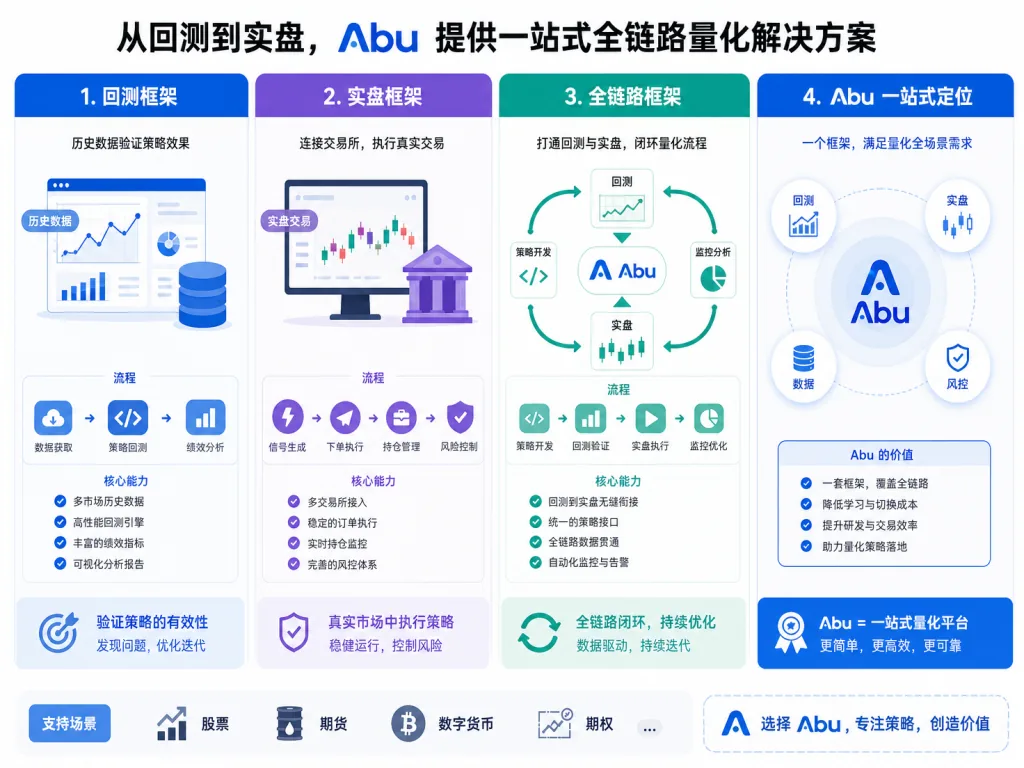
Abu is an open-source quantitative trading system aimed at Chinese-speaking users, built around the pitch of "one-stop, full-chain quant" — market data ingestion, strategy authoring, historical backtesting, paper and live trading, plus risk control and capital management, end to end. It packages the modules commonly used in quant trading into reusable components, so developers can focus on the strategy itself instead of rebuilding infrastructure over and over.
The project is still early (a modest star count), but the code structure is clear, which makes it a good reference implementation for learning how a quant system is architected — and usable as-is for small and mid-sized live trading setups.
3. Core features in depth
1. Multi-market data access and data management
Abu ships wrappers for market data feeds across A-shares, futures, crypto and other common markets, with daily, minute and tick-level data plus local caching. It abstracts data from different sources into a unified structure, so strategy code doesn't need a separate adapter per exchange.
The design mirrors many professional platforms: a data-source adapter plus a unified DataFrame hides the underlying differences. The result is that the same moving-average strategy runs on A-shares and on crypto — only the data source config changes, not the strategy logic.
2. Strategy authoring and the backtest engine
Abu exposes a Python strategy API, and the backtest engine is event-driven rather than plain vectorized computation, so it models order fills, slippage and commissions far more realistically. It includes common timing strategies (moving averages, turtle trading, machine-learning signals) and stock-selection factor examples, so newcomers can fork one and see results immediately.
Compared with pure backtesting tools such as backtrader, Abu wires backtest results straight into the paper and live trading modules: a strategy that passes backtesting can be switched to paper trading in one step, which removes a lot of duplicate integration work.
3. Paper trading and live trading
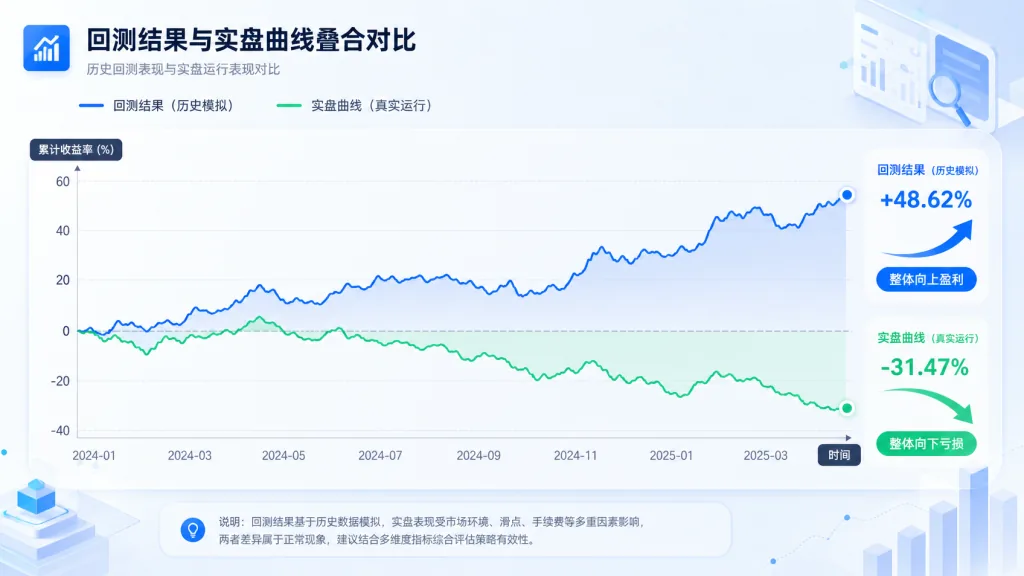
Going from backtest to live usually means writing the order logic all over again — one of the biggest sources of duplicated work in quant. Abu abstracts order placement behind a Broker interface, so backtest, paper and live share one order API; switching modes only takes a config change at startup.
This "one strategy codebase for the whole lifecycle" design makes the path from idea to live very short. For individual developers and small teams, it means lower maintenance cost and faster iteration.
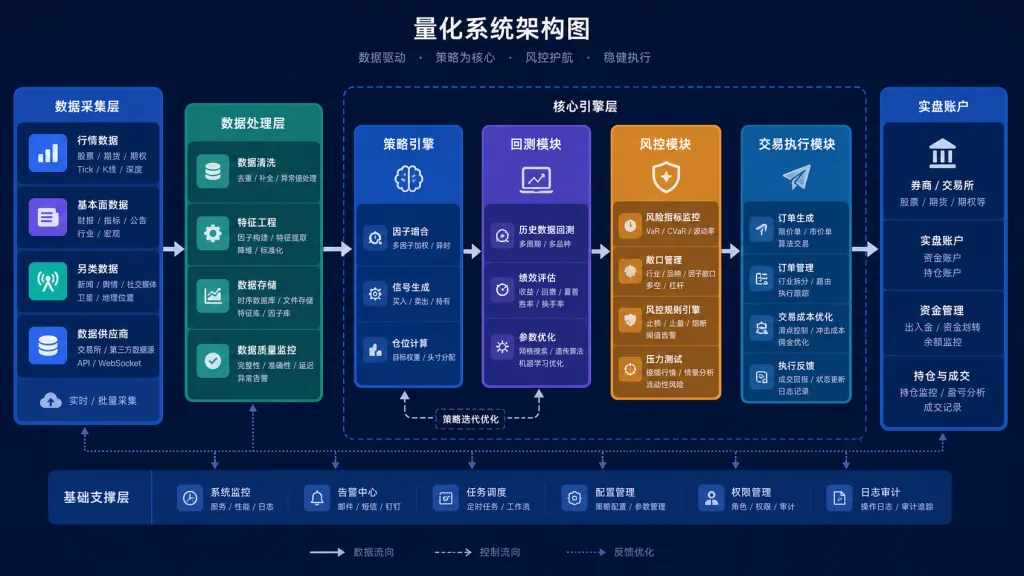
4. Risk control and capital management
Abu includes common risk rules — position limits, max-drawdown stop-loss, whitelists and blacklists, circuit breakers for abnormal market conditions — configurable at the strategy level. The capital management module supports fixed sizing, pyramid adding and the Kelly criterion, so users can tune parameters to their own risk appetite.
4. Technical highlights and numbers
- Unified abstraction layer: market data, orders and accounts are all interfaces, so adding an exchange or broker only requires an adapter — strategy code stays untouched.
- Event-driven backtesting: compared with purely vectorized backtests, it models how matching order affects a strategy far more accurately, narrowing the gap between backtest and live results.
- Modular decoupling: data, backtesting, risk control and trading are independent and can be used on their own — for example, dropping only Abu's risk module into an existing system.
- Python ecosystem compatibility: the core is Python, plugging straight into pandas, numpy and scikit-learn, so writing ML strategies doesn't mean switching languages.
5. Where it fits, and who it fits
Who it suits:
- Individual quant hobbyists who want to go from a strategy idea to live trading without building a wheel at every step;
- Engineers studying quant system architecture who want a complete reference implementation to read;
- Small quant teams that need one framework to manage the lifecycle of multiple strategies.
Who it doesn't suit:
- Institutional high-frequency scenarios (millisecond-level latency requirements);
- Pure traders who don't want to write any code (basic Python skills are still required).
6. How it compares
| Project | Positioning | How it differs from Abu |
|---|---|---|
| Backtrader | Pure backtesting framework | Strong at backtesting, but live trading and integration are on you |
| Zipline | Veteran backtesting framework | Community activity has declined, thin A-share/crypto support |
| vnpy | Mainstream Chinese quant platform | Heavier and more complete, steeper learning curve |
| Abu | Lightweight full chain | Covers backtest through live trading, clear structure, fits small and mid-sized use |
The core reason to pick Abu: it isn't the biggest or the most complete, but it finds a balance between covering the full chain and staying lightweight, which makes it especially good for individuals and small teams validating strategy ideas quickly.
7. Getting started quickly
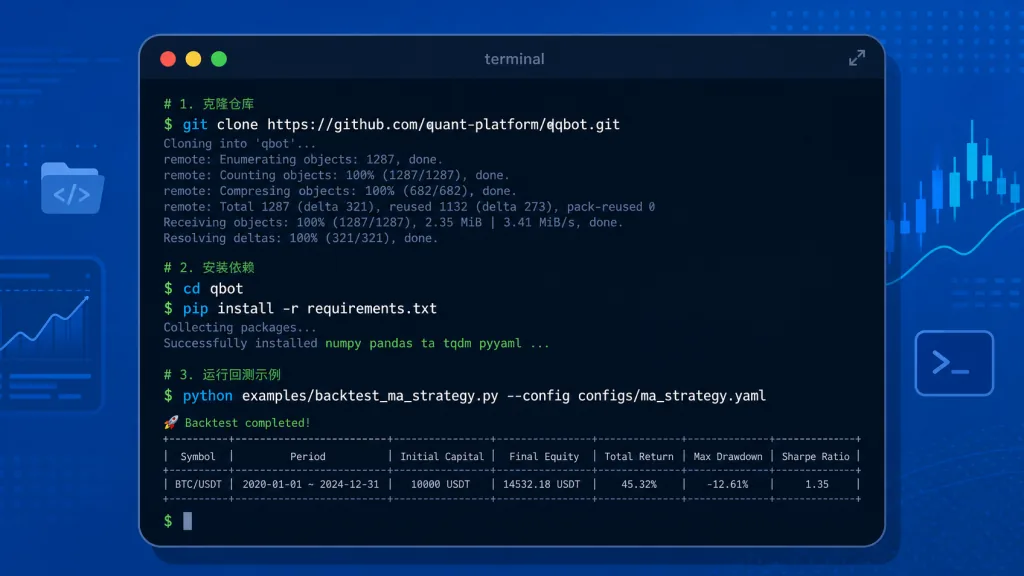
- Set up the environment: Python 3.8+, then install base dependencies such as pandas and numpy.
- Clone the repo:
git clone https://github.com/bbfamily/abu && cd abu - Install dependencies:
pip install -r requirements.txt - Run the example: go into the
exampledirectory, run the moving-average strategy script and look at the backtest report. - Go live: switch the Broker to live mode in the config file and fill in your broker/exchange keys to start.
Advanced advice: run it in paper trading for 2–4 weeks first, and only go live once the strategy looks stable; also turn on the risk module's drawdown alerts instead of running naked.
8. Takeaways
Abu's core value is that it packages everything between a quant "idea" and "live trading" into one reusable framework, so you can focus on the strategy instead of repeatedly wiring up infrastructure.
If you're stuck on market data integration, a backtest/live split, or missing risk control, it's worth browsing the code and running the examples at https://github.com/bbfamily/abu. One-line pitch: Abu makes the whole quant chain, for the first time, "write once, run everywhere."
#abu #Abu #bbfamily #OpenSource #GitHub