
1. Intro: why you need this tool
It's 2 a.m., you're staring at the 800 lines an AI agent just generated in your IDE, and your brain is stuck on one question: can any of this actually ship?
Half an hour in Cursor and a new feature appears, smooth as a demo. Then you get ready to merge into main and your palms start sweating. Is branch coverage enough? Did it trip over the edge cases? Did the agent quietly pull in a dependency with a known CVE? The worst part: you want to review it, but the volume has already blown past what you can audit by hand.
Every developer in the Vibe Coding era shares this problem. Agents pushed generation speed to the limit, while verification stayed in 2015. The result: 10x more code, not 1x more confidence.
The 2024 Stack Overflow Developer Survey found that 77% of developers are using or planning to use AI coding assistants, but only 29% say they "highly trust" AI-generated code. The gap sits squarely in verification.
So what if there were a way to make the agent prove its own code is fine, and all you have to do is read two documents? Which would you pick?

2. Project overview: what it is in one sentence
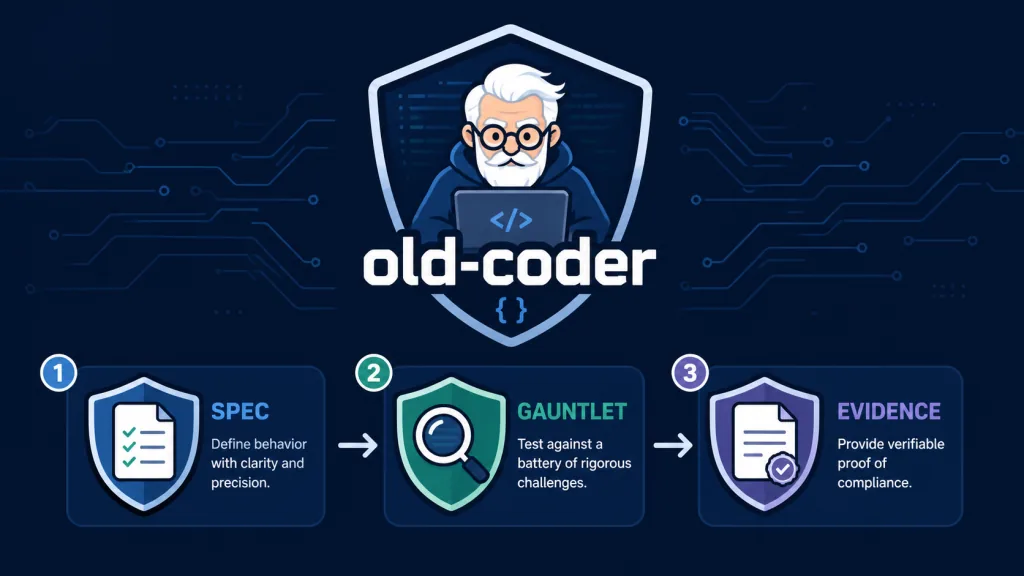
old-coder is an "evidence-first development" Skill for AI coding agents, built on one claim: "don't read the code — make the code pass the full gauntlet." It doesn't read your code. Instead it makes the agent submit two documents, a SPEC (test plan) and an EVIDENCE (evidence report), turning verification into something standardized, automated and auditable.
Four keywords capture the core: Test-First, Mutation Testing, Change-line Coverage, Supply Chain Audit. It works with Claude Code, Codex CLI, Cursor, Aider and any custom agent loop — plain Markdown, zero runtime dependencies.
As of now the project has 331 stars. The main repo is written in Python, but the Skill itself can drive a project in any language.
3. Core features in depth
1. SPEC first: write the test plan before you write the code
Classic TDD is "write the test, then write the implementation." old-coder lifts that idea to the spec level: before generating any code, the agent must output a SPEC.md that spells out what the code must do, what it must not do, and which tools it depends on. You review that one document and say yes or no.
This step turns requirement boundaries from "a verbal description" into "acceptance clauses," and moves the window for supply chain attacks and hidden dependencies forward into the approval stage.
2. The standard RED → GREEN → REFACTOR loop
The Skill bakes in the classic red-green-refactor rhythm, plus one iron rule: once the tests are written, they may not change while the run is in progress. That rule kills the agent's favorite cheat outright — editing the tests so the code passes.
3. The GAUNTLET: eight automated gates
Once the implementation is done, the agent must run eight checks in order:
- Full test suite — did anything break existing behavior?
- Type check + lint + cyclomatic complexity — any rookie mistakes or unreadable code?
- Change-line coverage — is every new line covered by a test?
- Mutation testing — inject bugs on purpose and see whether the tests catch them?
- Property-based testing — can the code survive hundreds of randomized inputs?
- Real execution — outside the test harness, does it actually run in a real environment?
- Supply chain and secret scanning — did it pull a dangerous package? Did it leak a key?
- Suite health — are the tests themselves stable? Do they pass in any order?
Based on the task risk model, it also appends specialized layers from references/gauntlet.md for concurrency, UI, API compatibility, performance, observability and more.
4. The EVIDENCE report: numbers, and one command to rerun it
The agent grades itself, but under strict rules: checks it never ran can only be marked unverified, never pass; a report without an approved SPEC must say so up front and lower its confidence. The output is evidence.md, filled with numbers that were actually measured — not a line saying "looks fine to me."
The repo ships a demo-rate-limiter walkthrough: 17 tests, 100% branch coverage on new code, 8/8 injected mutant bugs caught. More importantly, the whole flow surfaced a real bug where a NaN time window bypassed validation — something the unit tests alone never exposed.
4. Technical highlights and performance data
On architecture, old-coder uses a two-layer Skill + Reference structure: SKILL.md holds the main flow, references/gauntlet.md holds the gate checklist. Lightweight, pluggable, portable — the engineering philosophy of "one Skill, one class of problem."
Three core innovations:
- Docs as the interface: the agent's output converges on two artifacts, SPEC and EVIDENCE, moving human attention away from the code itself and onto acceptance clauses and evidence numbers.
- Mutation testing made practical: most projects only measure coverage. old-coder puts mutation testing in the default gate list, which directly exposes fake tests that look green but assert nothing.
- A self-honest evaluation mechanism: rules constrain the agent so it cannot cheat. This is one of the few open-source projects that designs "AI evaluating AI" as an auditable process.
Ecosystem compatibility is the other highlight. Install with one line, npx skills add https://github.com/amazingang/old-coder; it supports Claude Code's /old-coder slash command and can also plug into Codex CLI, Cursor and Aider through AGENTS.md.
5. Use cases and who it's for
Scenario one: refactoring financial or payment systems For core modules handling money, login and concurrent data access, the full old-coder gate list (concurrency layer included) blocks the vast majority of regressions. Traditional code review stopped working at this code volume long ago.
Scenario two: legacy system migration Rewriting an old Java or PHP service in Go or Rust: agents produce fast, but the risk is high. old-coder's change-line coverage plus real-execution layer keeps the baseline intact throughout the migration.
Scenario three: maintaining an open-source library An individual developer maintains a library with thousands of stars and has no time to review community PRs line by line. Let contributors submit an EVIDENCE report through the old-coder flow, and you only read two documents.
Who it's for: mid-to-senior engineers writing core business code with AI agents; tech leads who want a coding-agent usage standard for the team; full-stack developers anxious about "Vibe Coding safety."
Who it's not for: developers doing purely one-off scripts or prototype demos, or freelancers who refuse any process constraint at all.

6. Comparison with alternatives
| Dimension | old-coder | Aider --watch | Cursor built-in tests | Cline + custom hooks |
|---|---|---|---|---|
| Process (SPEC→GAUNTLET→EVIDENCE) | ✅ Complete | ❌ None | ❌ None | ⚠️ Configure it yourself |
| Mutation testing on by default | ✅ | ❌ | ❌ | ❌ |
| Change-line coverage tracking | ✅ | ❌ | ⚠️ Overall coverage only | ❌ |
| Supply chain / secret scanning | ✅ | ❌ | ❌ | ⚠️ Needs extra tooling |
| Cross-agent compatibility | ✅ 6+ agents | ⚠️ Aider only | ❌ Cursor only | ⚠️ Cline only |
| Learning curve | Low (plain Markdown) | Medium | Low | High |
Put simply: if what you want is "the agent proves itself and you read two documents," old-coder is currently the only project on GitHub that turns this into an end-to-end Skill. Everything else either only generates code or only works inside one particular agent.
7. Quick start
Option one: one-line install
npx skills add https://github.com/amazingang/old-coder
Option two: manual integration (Claude Code)
cp -r skills/old-coder ~/.claude/skills/
Then invoke /old-coder, or ask for something in the spirit of "prove it works" in the conversation and the Skill triggers automatically.
Option three: wire up other agents
Copy the contents of skills/old-coder/SKILL.md into your AGENTS.md, Cursor Rules or system prompt, and put references/gauntlet.md in the same directory.
Minimal working example: go into demo-rate-limiter and run ./tools/gauntlet.sh — one command reproduces the full evidence.md, so you can see how the eight gates run and how the report gets generated.
Going further: plug the SPEC template into your PR template and require an EVIDENCE report on every agent-generated PR. Over time your team gets a comparable, regression-tested quality baseline for agents.
8. Summary and next steps
In one sentence, old-coder's value is: make AI agents deliver code with evidence, not convince you with code. It redistributes attention between humans and AI along the production chain — humans define boundaries and approve; agents run every check and hand over the numbers.
Recommendations:
- Pilot it on an internal project first, picking one high-risk module to run through the full flow;
- Archive evidence.md in your CI artifacts as a basis for later audits;
- Build up your team's risk model over time so agents pick gates automatically instead of running the full set every time.
Project link: GitHub repo AmazingAng/old-coder; MIT licensed, usable commercially and redistributable.
In the agent era, being able to write code is no longer the edge — being able to accept the code an agent wrote is. old-coder turns that into an out-of-the-box Skill, and it belongs in the toolkit of anyone who leans heavily on AI for coding.