
Title options (pick 1 of 3)
Reverse engineering tools got locked behind paywalls? Ghidra's 90K stars just rebuilt the free workflow
From assembly to C-like code: Ghidra's decompiler makes reverse engineering an order of magnitude faster
Ghidra is the decompiler tool the NSA actually uses — so why is it free and open source?
Ghidra: a 90K-star decompiler the NSA runs in production — what makes this reverse engineering framework so strong
1. Intro: the pain every reverse engineer has hit
You pick up an unknown binary sample and want to know what it does, which calls it hides, which functions might be exploitable — and the moment you open IDA Pro, the trial clock starts counting down in parallel. Solo developers balk at the license fee, students queue for seats in the campus lab, and security researchers grind through stripped assembly inside closed-source software. It isn't only about money. It's about research velocity stalling once the tooling gets monopolized. Ghidra showed up and flipped the whole workflow over.
2. Project overview: what exactly is it?
Ghidra is a software reverse engineering (SRE) framework developed and maintained by the United States National Security Agency's research directorate, positioned as an open platform for security analysts and vulnerability researchers. It runs on Windows, macOS and Linux, and covers the full stack — disassembly, assembly, decompilation, graphical analysis, automation scripting — with support for dozens of processor instruction sets and executable formats. It currently has over 90K stars on GitHub and is one of the most-watched reverse engineering projects in the Java ecosystem.
3. Core features in depth
1. The decompiler: from assembly to C-like code
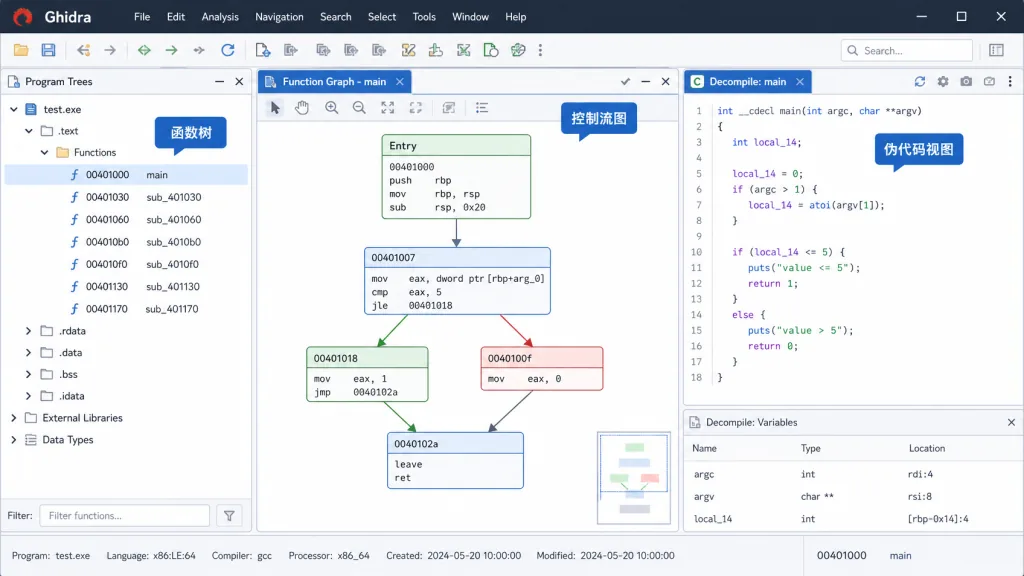
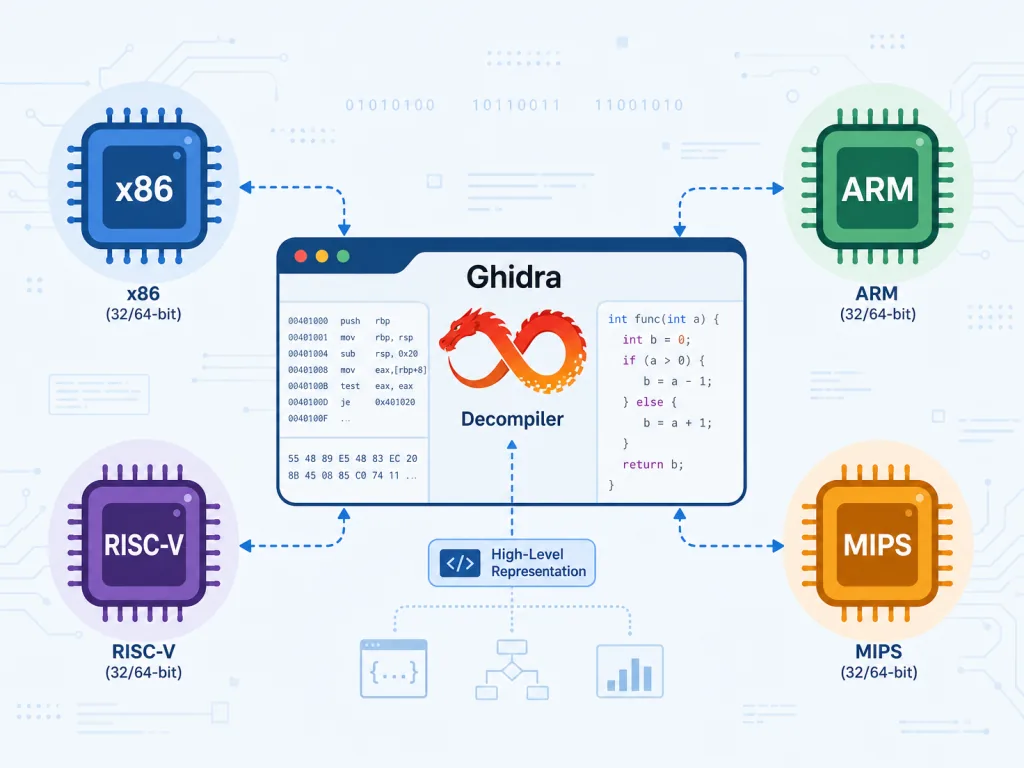
Ghidra's headline feature is its built-in decompiler, which translates binaries for x86, ARM, MIPS and other architectures straight into readable C-like pseudocode, sparing you the misery of reading assembly line by line. Open any PE or ELF file and you get a function tree on the left and a pseudocode view on the right, with variable naming and struct inference already applied. Compared to chewing through raw assembly, the decompiler output makes logic analysis an order of magnitude faster.
2. Multi-architecture, multi-format support
Ghidra maintains its own Sleigh instruction set description language, covering x86, x86-64, ARM/AArch64, MIPS, PowerPC, RISC-V and other mainstream architectures. Extension loaders also recognize PE, ELF, Mach-O, Java class, WebAssembly and more. One install carries you across embedded firmware analysis, desktop reverse engineering and mobile sample research.
3. Collaboration and automation
Reverse engineering is rarely a solo job. Ghidra ships a multi-user collaboration mode where analysis progress and annotations sync across a team; headless batch mode runs scripts with no UI, so you can wire it into a CI pipeline and scan firmware at scale. Paired with PyGhidra, analysts can run taint analysis, function similarity matching and YARA rule matching in bulk from Python.
4. Extensibility
Need a new feature? Write a plugin in Java or Python. The GhidraDev Eclipse plugin and the VS Code integration module are both officially supported, and custom analyzers, new processor modules and decompiler passes can all be packaged and shipped independently.
4. Technical highlights and performance data
Ghidra's main application is built on Java and uses the Eclipse Rich Client Platform (RCP) as its UI framework, which brings a highly customizable window and perspective system. The decompiler uses a static single assignment (SSA) intermediate representation combined with control-flow analysis, data-flow analysis and struct recovery algorithms to produce output that reads close to source code. The whole architecture was hardened inside the NSA over years of real-world use, and it stays stable on firmware in the hundreds of megabytes. On the ecosystem side, Ghidra coexists with Binary Ninja, Frida and radare2 and often serves as the decompilation layer inside a larger analysis chain; the community has also produced GhidraSnippets, Ghidra scripting templates, gef integrations and more, which plug quickly into binary vulnerability research and CTF work.
5. Use cases and who it's for
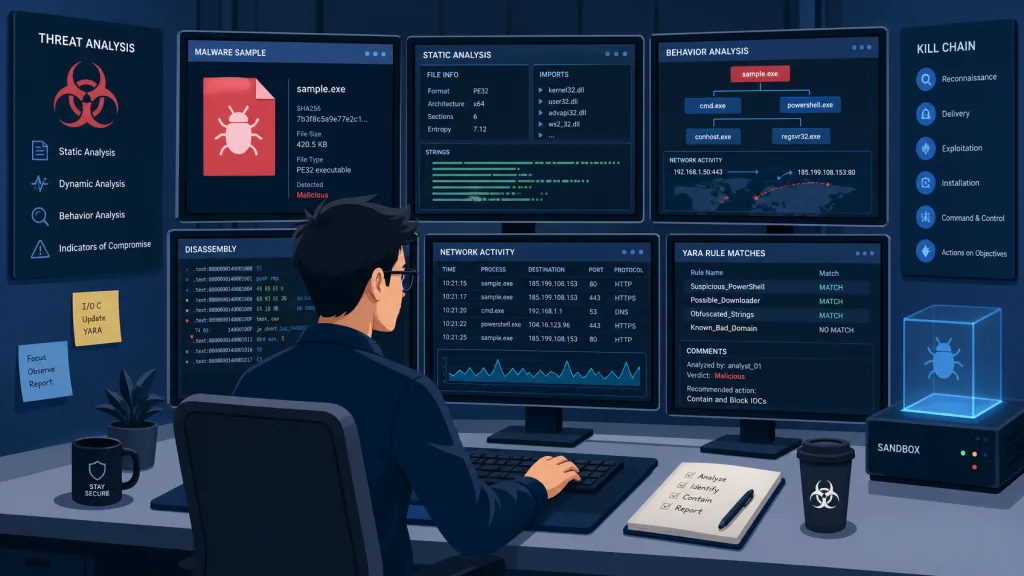
- Malware analysis: unpack sample behavior and extract IOCs (Indicators of Compromise) — a daily driver for SOC analysts and threat researchers.
- Vulnerability research: locate dangerous functions and build PoCs in closed-source binaries with no source available, which suits bug hunting and academic research.
- Firmware and IoT security: parse firmware images from routers, cameras and industrial controllers, and verify backdoors and hardcoded keys.
- CTF and security teaching: free, open source, with full decompilation — the default practice platform for universities and competition players.
Not a good fit: commercial product-grade SDK integration (the IDE runtime is heavy), and enterprises that want team collaboration hosted in the cloud (you have to stand up the server yourself).
6. Competitor comparison
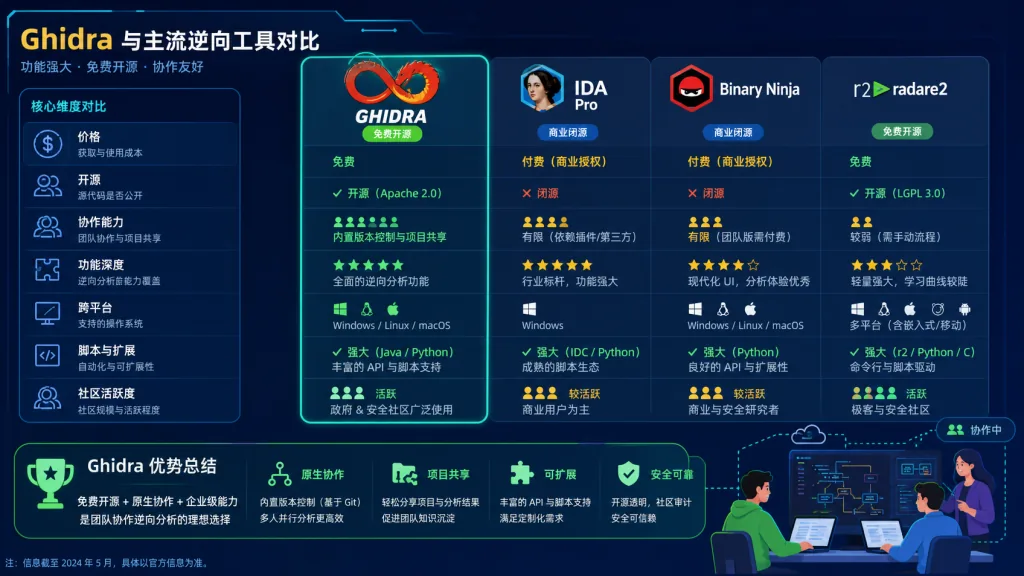
| Dimension | Ghidra | IDA Pro | Binary Ninja | radare2 |
|---|---|---|---|---|
| Price | Free and open source | Commercial license (thousands of dollars and up) | Tiered commercial licenses | Free and open source |
| Decompiler | Built-in, C-like | Built-in Hex-Rays (paid) | Built-in | Experimental, needs the r2dec plugin |
| Collaboration | Multi-user server | Requires third-party plugins | Weak | No native collaboration |
| Extension languages | Java / Python | IDC / Python / C++ | Python | Command line + r2pipe |
| Learning curve | Moderate | Moderate to steep | Fairly gentle | Steep |
The case for Ghidra is simple: on "free + built-in decompiler + collaboration" it is still the only tool that satisfies all three at once.
7. Getting started fast
- Install JDK 25 (64-bit).
- Download
ghidra_<version>_<release>_<date>.zipfrom the Releases page and extract it into its own directory (don't overwrite an older version). - Enter the extracted directory and run
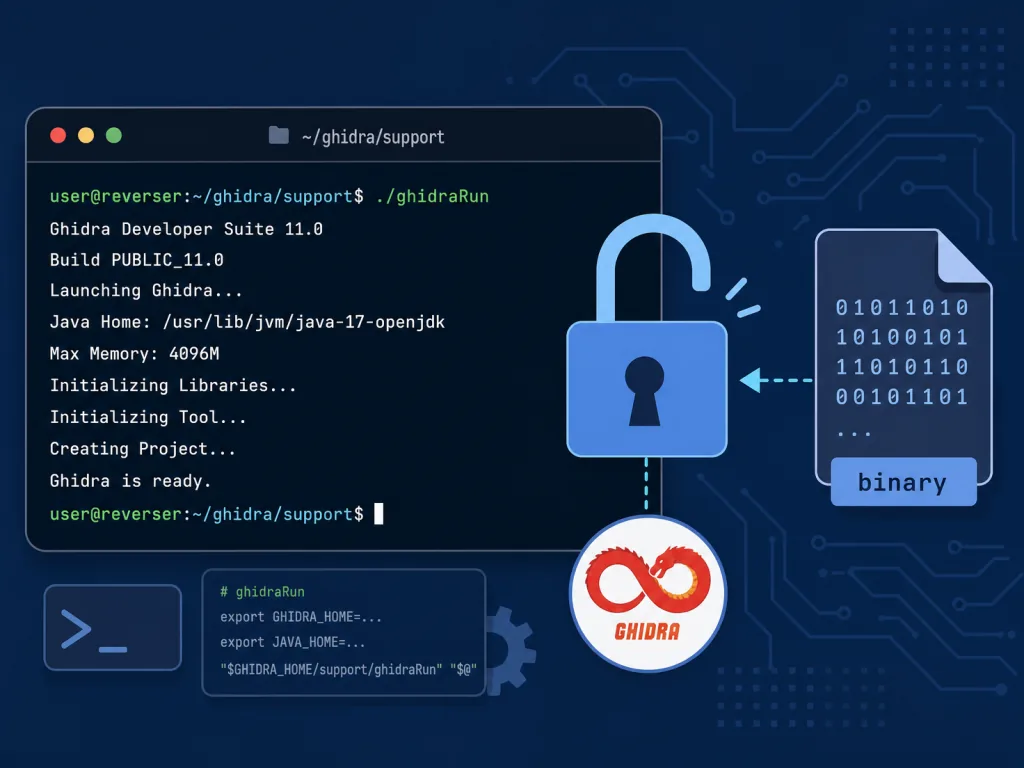
./ghidraRun(on Windows useghidraRun.bat). - In the project window, choose
File → New Project, import the binary you want to analyze, and let Ghidra run auto-analysis. - Want to script it? Try
./support/pyghidraRunto drop straight into a Python REPL against the current program.
Going further: install Eclipse plus the GhidraDev plugin, or in VS Code use Tools → Create VSCode Module project to generate a module project and start writing custom analysis scripts.
8. Summary and next steps
Ghidra redrew the reverse engineering toolchain the open-source way: free to use, feature complete, free to extend, so anyone serious about low-level security research can work on an NSA-grade workflow. Head to the Ghidra GitHub repository, grab the latest release, and run it on one real sample — you'll feel the speed and clarity for yourself. One-line recommendation: put Ghidra in your security toolbox and stop worrying about licenses.
#ghidra #Ghidra #nationalsecurityagency #GameDev #CyberSecurity #OpenSource #GitHub