
Title options (pick 1 of 3)
Tired of gluing inference services together? Modular open-sourced Mojo + MAX in one repo
Modular in 5 minutes: a working OpenAI-compatible inference service that competes on performance
The 30K-star Modular: an AI programming language, inference framework and acceleration library in a single repo
Modular goes open source: one repo for the Mojo language and the MAX inference framework — a 30K-star AI development kit
Almost everyone doing AI inference has tripped over the same flow: write the model in PyTorch, then assemble a deployment with tools like TorchServe, Triton or vLLM. Environment adaptation and performance tuning alone are a chore. Repeated serialization between Mojo and Python, GPU memory fragmentation, API differences across backends — each one slows the iteration cycle.
What stings more is how much hardware performance that flow leaves on the table. You have a 4090 but can't get anywhere near its throughput; you know a one-line CUDA kernel change would double the speed, but nobody on the team wants to touch that pile of C++ template code. The result: every time the model scales up after launch, you pay for the stacked runtime overhead.
Modular, the project in question today, packages all of that away.

2. Project overview: what exactly is Modular?
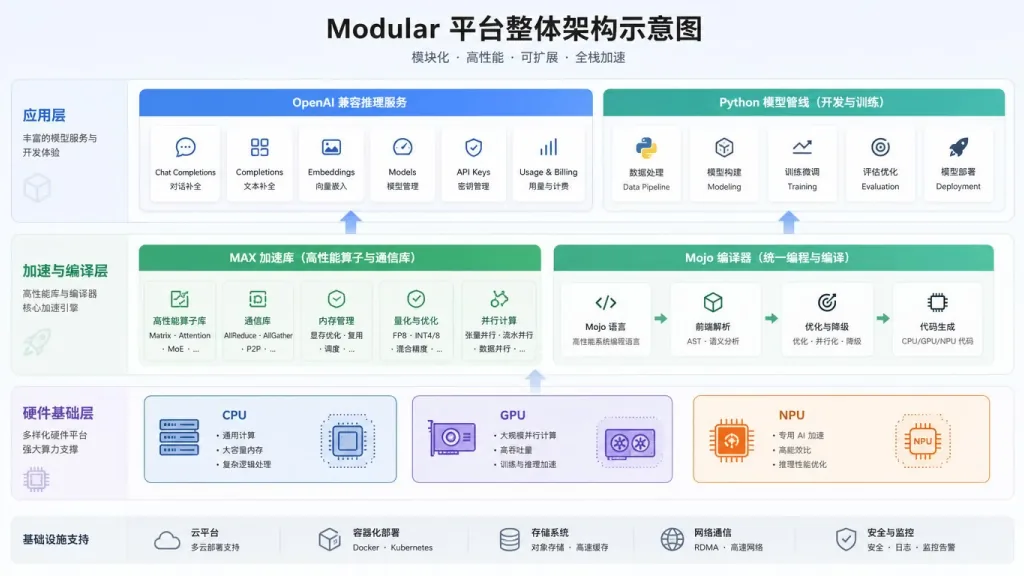
Modular is a unified platform for AI development and deployment, and the repository hosts two core pieces at once: the MAX Framework and the Mojo Language.
In one sentence: one repo that connects the entire AI inference chain — from compiler to acceleration library, from inference service to Python model pipelines — all open source.
Core keywords:
- Unified platform: MAX folds inference serving, model pipelines and acceleration libraries into one architecture, so you stop assembling them piecemeal;
- Mojo language: a new language for programming AI hardware, combining Python's expressiveness with C/C++-level proximity to the metal;
- Open-source collaboration: 29,938 stars, Apache 2.0 with LLVM Exceptions, and a community that can contribute to the standard library, kernels and model architectures.
The project isn't aimed at any single inference engine. It's aimed at "the next generation of AI infrastructure."
3. Core features in depth
1. The Mojo compiler: from Python thinking straight to hardware
Mojo is the AI-focused language Modular open-sourced. Its syntax looks like Python, but it builds in low-level capabilities such as SIMD, pointers and fn. Developers can write GPU/NPU-oriented kernels directly in Mojo, skipping the multi-layer translation of Python → C++ → CUDA. The official compiler is open source, and the standard library and kernels now accept community contributions too.
2. The MAX acceleration library (max/kernels)
MAX ships a kernels library with highly optimized operator implementations covering matrix multiplication, attention mechanisms, quantization and other common AI workloads. These kernels are written in Mojo, so they can be reused across multiple hardware backends and are faster than the default implementations in general frameworks — particularly on hardware that often gets neglected, like Apple Silicon and AMD GPUs.
3. OpenAI-compatible inference service (max/serve)
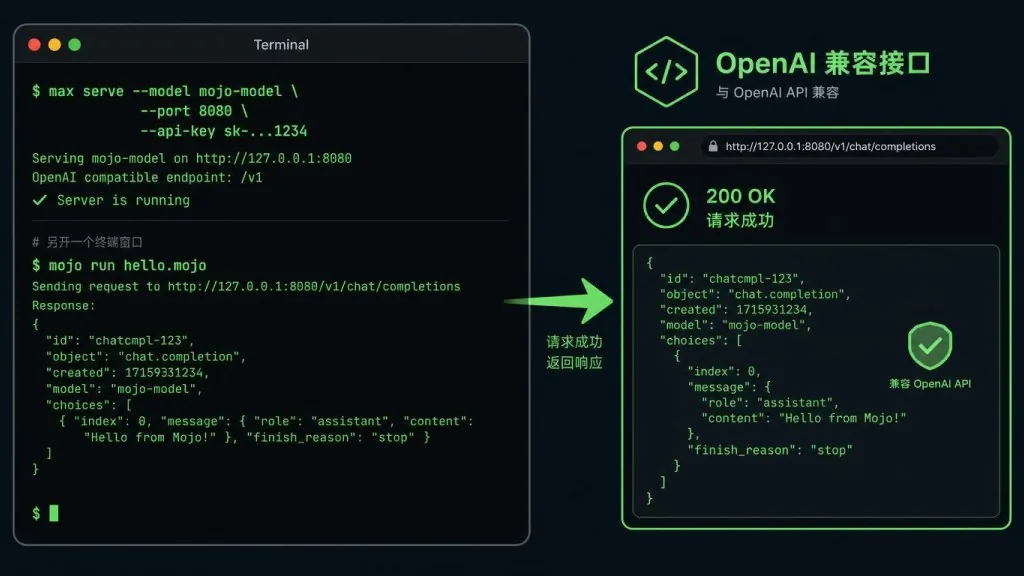
max/python/max/serve provides an OpenAI-compatible inference endpoint. That means existing applications built on the OpenAI API can switch to a local MAX inference service with almost no changes. Model weights can be pulled straight from Hugging Face, removing a separate deployment tool from the chain.
4. Python model pipelines (max/pipelines)
MAX provides Python-based graphs for describing model pipelines. Developers orchestrate preprocessing, inference and postprocessing in familiar Python, then hand execution to MAX for efficiency. This division of labor — "Python orchestrates, Mojo accelerates" — gives you both fast iteration and fast runtime.

4. Technical highlights and performance data
Modular made a few key architectural choices:
Full-stack open-source collaboration: compiler, standard library, acceleration libraries, inference service, Python pipelines and example code are all open and accepting contributions. Modular is one of the few AI platform companies that puts compiler source code on the table.
A hardware-agnostic acceleration layer: through custom Mojo kernel abstractions, MAX lets the same code run near peak performance on CPU/GPU/accelerators. The thinking resembles Triton or DLLM, but Modular packages language, library and service together, cutting the adaptation cost.
OpenAI API compatibility: the inference service speaks the OpenAI protocol directly, so clients migrate without changes, and existing ecosystem tools (LangChain, LlamaIndex and friends) work out of the box.
Ecosystem completeness: the official repo contains /max/examples and /Mojo/examples, from single-file demos to full deployment guides, so a newcomer can bring up their first inference service in 5 minutes.
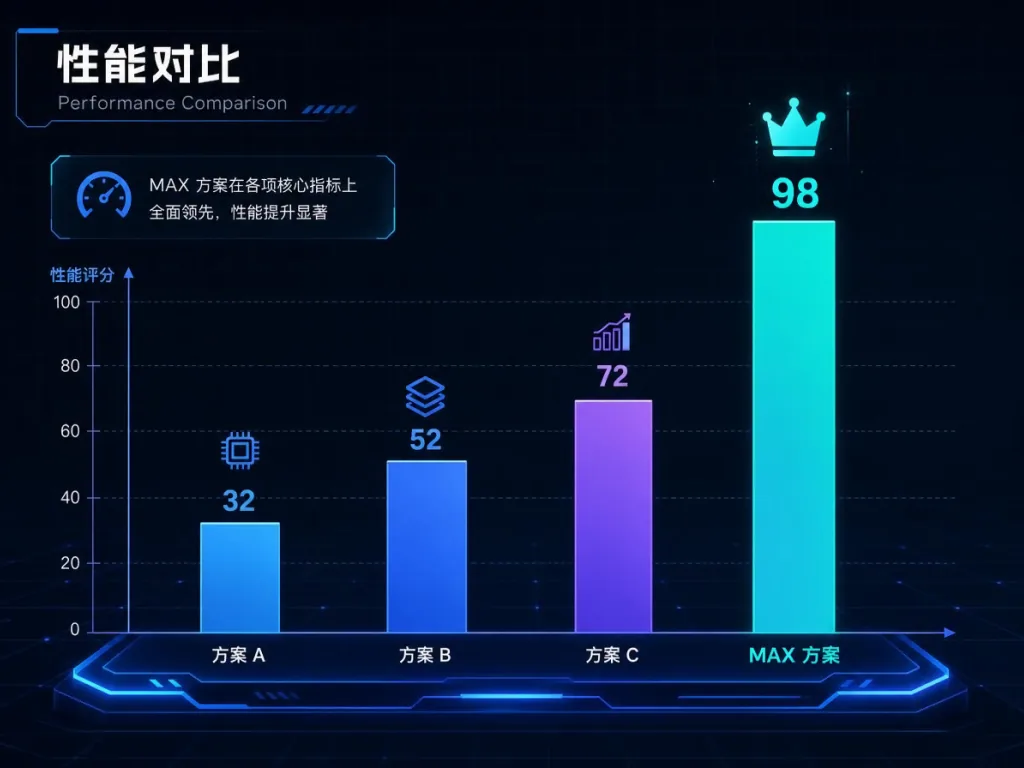
On performance, Modular has shown multi-fold throughput advantages over mainstream Python inference approaches in public benchmarks, but the exact numbers depend on hardware and model; the official docs provide detailed reproduction scripts.
5. Use cases and who it fits
Scenario one: high-throughput production deployment Backend and mid-tier teams that need to serve large models (LLMs, diffusion) on their own hardware, are sensitive to latency and want to control cost. MAX's OpenAI-compatible endpoint can directly take over part of a cloud inference service.
Scenario two: AI systems developers / kernel engineers
People who want to write high-performance operators themselves and don't want to grope around inside PyTorch's torch.compile black box. Mojo + MAX kernels offer a complete path from language to library.
Scenario three: education and research Teaching settings where students or researchers need to see the whole chain from "model → inference service → hardware". Modular is fully open source with clear docs, which makes it an excellent study sample.
Not recommended: beginners who just want "one command to start an LLM" — Ollama or LM Studio fit that better; nor people running only small CPU models, since the value of Mojo/MAX really shows on large models and heterogeneous hardware.

6. Comparison with alternatives
| Project | Positioning | Language stack | Hardware coverage | API compatibility |
|---|---|---|---|---|
| Modular / MAX | Unified inference platform + programming language | Mojo + Python | CPU/GPU/Apple Silicon/AMD | OpenAI compatible |
| vLLM | High-throughput LLM inference service | Python + CUDA | Mostly NVIDIA GPUs | OpenAI compatible |
| Triton Inference Server | General-purpose model inference service | Python (multiple backends) | Many hardware targets | Mostly custom protocols |
| Llama.cpp | Lightweight local LLM inference | C/C++ | CPU/GPU in general | CLI/GGUF |
Modular's core differentiator: it delivers "dedicated language + inference framework + acceleration library" as one unit, all open source. The goal isn't to replace vLLM but to offer a complete alternative stack, from the low-level language up to the service layer.
7. How to get started fast
1. Install the MAX CLI (macOS / Linux recommended)
curl -fsSL https://max.modular.com/install.sh | bash
2. Start an OpenAI-compatible inference service
max serve --model modularai/Llama-3.1-8B-Instruct
Once the service is up, http://localhost:8000/v1/chat/completions is a standard OpenAI endpoint that LangChain, Cursor, Continue and similar tools can call directly.
3. Try Mojo
curl -fsSL https://mojolang.org/install.sh | bash
modular install mojo
Then write a hello.mojo:
fn main():
    print("Hello from Mojo!")
Run mojo run hello.mojo and you'll see the output.
Going further: get the official demos in /max/examples running first, then read /max/docs to learn pipeline orchestration; if you want to contribute code, the standard library and kernels are the easiest entry points.
8. Wrap-up and recommended next steps
Modular's core value is "full-stack unification plus fully open source": Mojo pulls AI programming up to a level that can compete with C++, and MAX compresses the inference service development cycle down to minimal dependencies. For teams chasing performance and control, this is a proposal worth evaluating seriously.
Recommended next steps:
- Evaluators: bring up a local model with
max serveand compare throughput and latency against your current setup; - Developers: read the MAX docs plus the official Mojo manual, then try rewriting a custom kernel;
- Contributors: start with the standard library, kernels or model architectures — each has an active maintenance team.
Project links:
- GitHub: https://github.com/modular/modular
- MAX docs: https://max.modular.com/
- Mojo docs: https://mojolang.org/docs/
One-line recommendation: if you're fed up with the patchwork feel of the AI inference stack, it's time to look at Modular's "language + framework + service" full-stack approach.
#modular #Modular #Database #OpenSource #GitHub