1. Why you need this tool
Director Wang at a hospital IT department recently ran into a nasty problem: the department wanted to deploy a clinical NLP system to extract diseases, drugs and dosages from electronic medical records. Security killed it with one sentence — "patient records cannot leave the hospital intranet." He tried three cloud vendors in a row, each requiring a security review and a data processing agreement, with quotes starting at ¥360k a year.
This isn't an isolated case. Compliance requirements around medical data leave a huge number of teams stuck at the first step of "let's use AI for something": HIPAA, GDPR and internal hospital network policies all say the same thing — don't send PHI to an external API. But once you demand 100% localization, the open-source options that can actually run clinical NER are few and far between, and most only support English.
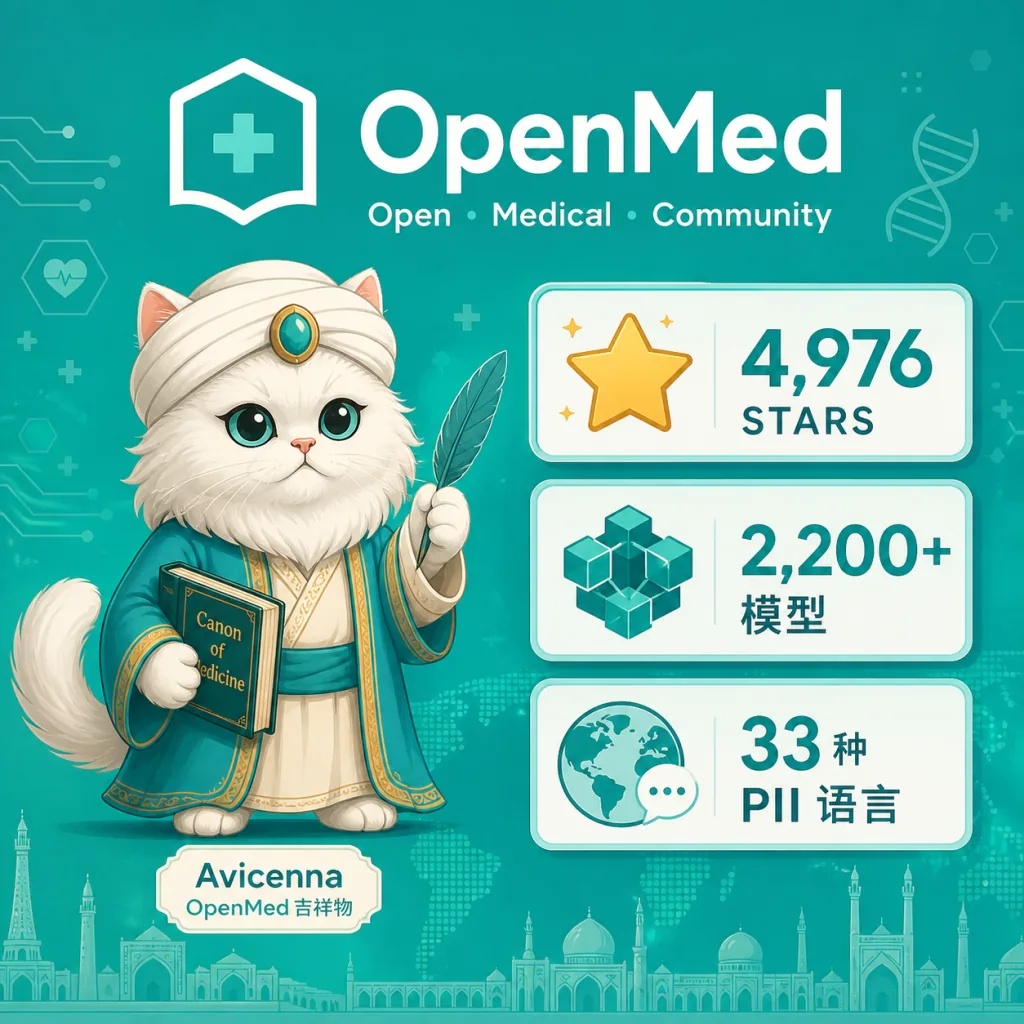
OpenMed targets exactly this contradiction: runs locally, a huge catalog of medical models, multilingual PII coverage, and de-identification built in. 4,976 stars on GitHub, over 3.4 million monthly downloads on PyPI, and already running steadily on intranet workstations in a number of hospitals.
2. What it is, in one sentence
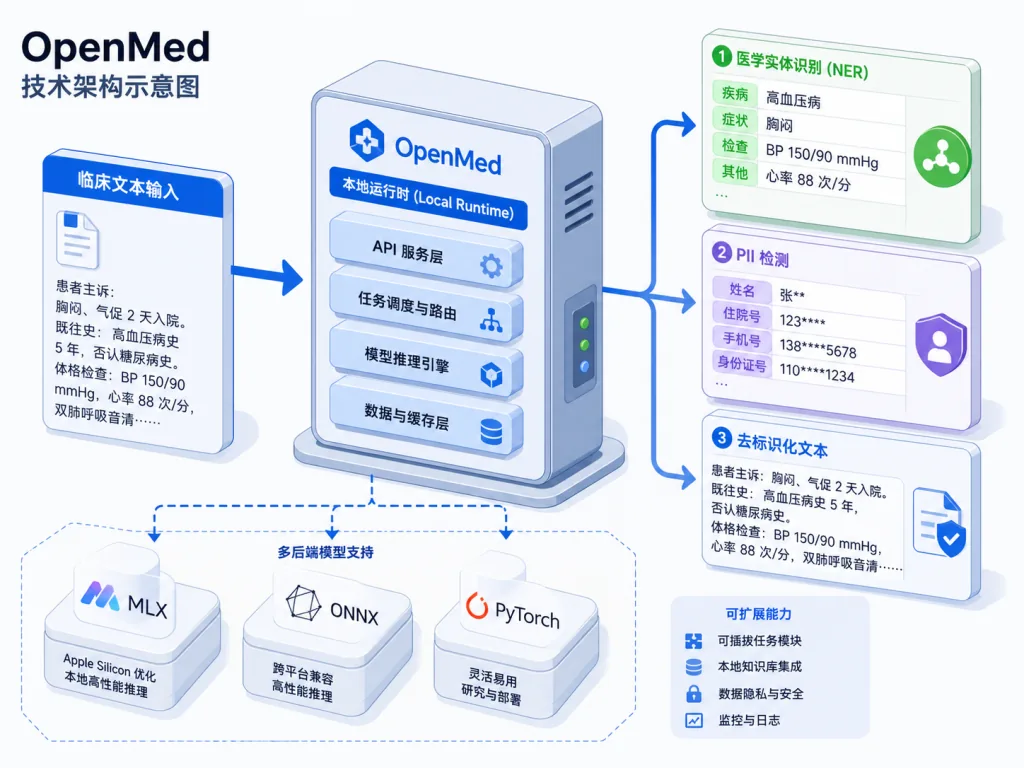
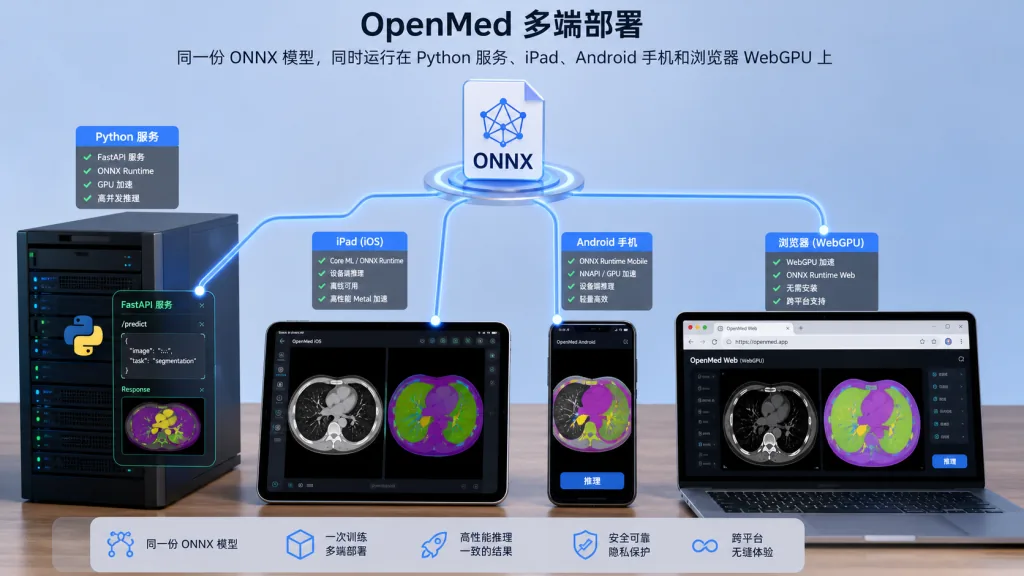
OpenMed is a local-first medical AI toolkit built around two main threads: clinical named entity recognition (NER) and HIPAA-aligned PII de-identification. 2,200+ medical models, 33 PII languages, Apache-2.0. The core runtime is fully offline by default — data never leaves the intranet — and deploys to CPU, CUDA, Apple MLX, Android ONNX and the browser. The SDK is Python, with Swift/Kotlin on mobile, plus a REST service, FHIR/HL7 interoperability and Transformers.js export already in place.
3. Core features in depth
1. Clinical NER: diseases, drugs, anatomy, genes
OpenMed's model catalog covers five verticals: disease_detection_superclinical (disease/diagnosis, 434M), pharma_detection_superclinical (drug/treatment, 434M), pii_superclinical_large (PII, 434M), anatomy_detection_electramed (anatomy/organs, 109M) and gene_detection_genecorpus (genes/proteins, 109M). One line of code calls them:
from openmed import analyze_text
result = analyze_text(
    "Patient started on imatinib for chronic myeloid leukemia.",
    model_name="disease_detection_superclinical",
)
for entity in result.entities:
    print(f"{entity.label:<12} {entity.text:<28} {entity.confidence:.2f}")
Output: DISEASE chronic myeloid leukemia 0.98; DRUG imatinib 0.95. This out-of-the-box API shape means clinical NLP no longer needs weeks of annotation and fine-tuning.
2. PII de-identification: HIPAA Safe Harbor aligned
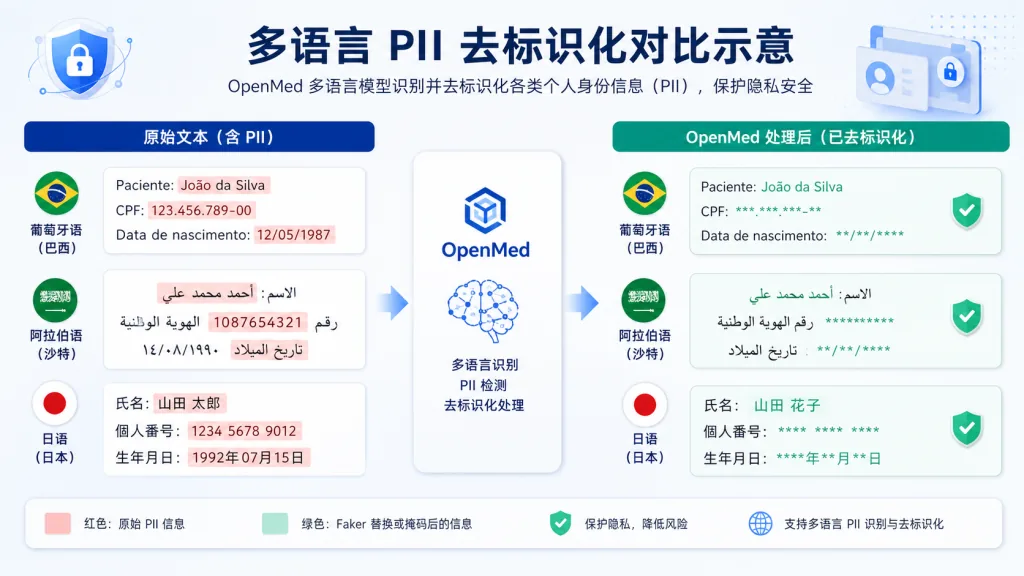
extract_pii and deidentify form the privacy core. It supports 18 identifier types, covering names, birthdays, SSNs, phone numbers, emails, addresses, medical record numbers and more. Four masking methods: mask, replace (Faker swaps in same-language fake data), hash, and shift_dates (date shifting that preserves the time series).
Worth noting is the smart entity merging mechanism: traditional NER often slices 01/15/1970 into three fragments — 01, /15, /1970 — while OpenMed's merge strategy keeps a full date, phone number or ID as one entity, so downstream rule engines don't miss it.
3. 33 PII languages + national ID validation
From Arabic 29801011234567 to Japan's My Number 1234 5678 9012, the Dutch BSN, Brazil's CPF and Spain's DNI, OpenMed ships a matching Faker locale and validator for each. A single lang="ja" switches it; no manual loading of multiple models.
4. Multi-platform deployment: Python / Swift / Kotlin / browser
The same ONNX model runs on a Python CPU, on Android ONNX Runtime Mobile, on Apple MLX on iOS, and in the browser via Transformers.js + WebGPU. For field scenarios that need offline record entry on a phone, OpenMedKit (Swift) provides a scan-and-de-identify pipeline.

4. Technical highlights and performance numbers
MLX acceleration shines on Apple Silicon: Privacy Filter inference latency is 24–33× faster than CPU PyTorch (median inference latency). Batch PII processing improves throughput 3.3× on CPU and 2.2× on MLX compared with per-document processing.
A few architectural points worth noting:
- OpenAI Privacy Filter architecture as the base (gpt-oss-style sparse MoE + local attention + sink tokens + RoPE+YaRN + tiktoken
o200k_base), with OpenMed providing three variants (baseline, Nemotron fine-tune, multilingual) behind the same API; - Automatic backend routing: an MLX model name falls back to the PyTorch checkpoint on non-Apple hardware;
- Offline/air-gapped deployment: point
model_idat a local directory and the runtime never contacts the Hugging Face Hub again; - Ecosystem compatibility: PyTorch, CUDA, MLX, CoreML, ONNX Runtime Mobile, Transformers.js and WebGPU all covered;
- REST service exposes four endpoint groups —
/health,/analyze,/pii/extract,/pii/deidentify— with keep_alive, hot model unloading, API key/JWT, dynamic batching, rate limiting and observability metrics.
5. Use cases and who it's for
Typical scenarios:
- A hospital IT department needs to structure ten years of electronic records in bulk and extract entities, without data leaving the intranet;
- An insurtech company de-identifies claims text on a local workstation before feeding it downstream;
- Cross-border multilingual record research that needs to extract from Portuguese, Arabic, Japanese and Turkish mixed together;
- A mobile follow-up app lets doctors enter records offline on an iPad and automatically masks patient names;
- Academic research pipes de-identified clinical data into cohort analysis via FHIR/HL7.
Who it's for: healthcare IT engineers, clinical researchers, medical NLP teams, medical SaaS startups, and integration vendors that need compliance audits. Who it's not for: pure algorithm hobbyists who just want to run a few public dataset demos and don't care about local deployment — cloud inference on Hugging Face is less hassle.
6. How it compares
| Dimension | OpenMed | AWS Comprehend Medical | Hugging Face cloud NER | Self-trained BERT-Biomedical |
|---|---|---|---|---|
| Deployment | Local / mobile / browser | Cloud API only | Cloud API only | Local |
| Model count | 2,200+ medical models | Single closed model | General models | Train your own |
| Multilingual PII | 33 languages + national ID validation | Limited | Configure yourself | Build from scratch |
| De-identification methods | 4 + policy config files | Single option | None built in | None built in |
| Data leaves the network | No by default | Mandatory | Mandatory | Optional |
| License | Apache-2.0 | Commercial | Apache/MIT | Your own |
There's really only one core reason to choose OpenMed: it's one of the few open-source options that simultaneously satisfies "rich vertical medical models," "fully local" and "multilingual PII built in" — and the SDK is Apache-2.0, so there's no licensing friction for commercial use.
7. Getting started fast
1. Install (30 seconds)
# CPU / CUDA
pip install --upgrade "openmed[hf]"

# Apple Silicon acceleration
pip install --upgrade "openmed[mlx]"

# REST service
pip install --upgrade "openmed[hf,service]"
2. Minimal working example
from openmed import analyze_text

result = analyze_text(
    "Patient received 75mg clopidogrel for NSTEMI.",
    model_name="pharma_detection_superclinical",
)
print([(e.label, e.text) for e in result.entities])
3. Further tips
- In an intranet environment, point
model_idat a pre-downloaded local directory so it runs even when the network is down; - Use
BatchProcessor(operation="deidentify", batch_size=16)for tens of thousands of documents; - For production, start the REST service from the Docker image with
OPENMED_PROFILE=prod; - For Android integration see
android/README.md, for iOS seeswift/OpenMedKit; - Agent developers can run
./install-skills.shto inject the skill into Claude Code / Codex / OpenCode.
8. Takeaways and next steps
OpenMed breaks the default assumption that "medical NLP has to go to the cloud." 2,200+ models, 33 PII languages, 24× speedup on Apple MLX, Apache-2.0 commercial friendliness, plus full iOS/Android/browser coverage — this is no longer a demo project but an engineered solution you can drop onto a hospital intranet workstation.
How to use it: first run disease_detection_superclinical against real samples from your department and confirm entity accuracy; then add pii_superclinical_large as a compliance guardrail; finally connect it to your existing ETL through the REST service or Docker image. If you're working on a multilingual project, run the lang="pt", lang="ja" and lang="ar" end-to-end demos — see for yourself whether the Faker-generated fake data matches local conventions.
- GitHub: https://github.com/maziyarpanahi/openmed
- Website: https://openmed.life/
- Docs: https://openmed.life/docs/
- PyPI: https://pypi.org/project/openmed/
- Paper: https://arxiv.org/abs/2508.01630
One-line pitch: if you're tired of the tug-of-war between "records can't leave the intranet" and "NLP accuracy," OpenMed is the open-source medical AI toolkit most worth running on your local workstation right now.