
Title options (pick 1)
Lost in multilingual TTS options? This 0.5B CosyVoice 3 fixed me
CosyVoice 3 puts 9 languages, 18+ dialects and 150ms streaming into a 0.5B model
A 0.5B model beating 1.5B rivals: why CosyVoice 3 tops the hard-sample leaderboard
1. Opening: almost every developer has hit this pain
Anyone who has worked on speech synthesis knows the meltdown: the model runs, but the synthesized Chinese sounds like a script being read aloud, and the English turns into "chinglish". You want dialect support and get Mandarin only. You want streaming and the latency starts at 500ms, which is unusable for conversation. There are plenty of open-source TTS projects around, but taking one to production means stepping on one pothole after another.
On our most recent project the requirements were clear: a model under 500MB, support for 9 languages including Chinese, Japanese, Korean, English and German, 18+ dialects, streaming latency around 150ms, and zero-shot voice cloning. After a round of comparison, CosyVoice 3 (Fun-CosyVoice3-0.5B-2512) looked almost tailor-made for that list.

2. In one sentence: what this project is
CosyVoice is an LLM-based TTS toolkit open-sourced by the FunAudioLLM team. CosyVoice 1.0 shipped in 2024, 2.0 followed late that year, and CosyVoice 3 landed in May 2025 (paper arXiv:2505.17589). The latest release targets "in-the-wild speech generation": 9 major languages and 18+ Chinese dialects, just 0.5B parameters, and 5.44% CER / 75.0 SS on the test-hard set — better than most 1.5B-scale rivals.
3. Core features in depth
1. Multilingual + dialect cross-lingual zero-shot cloning
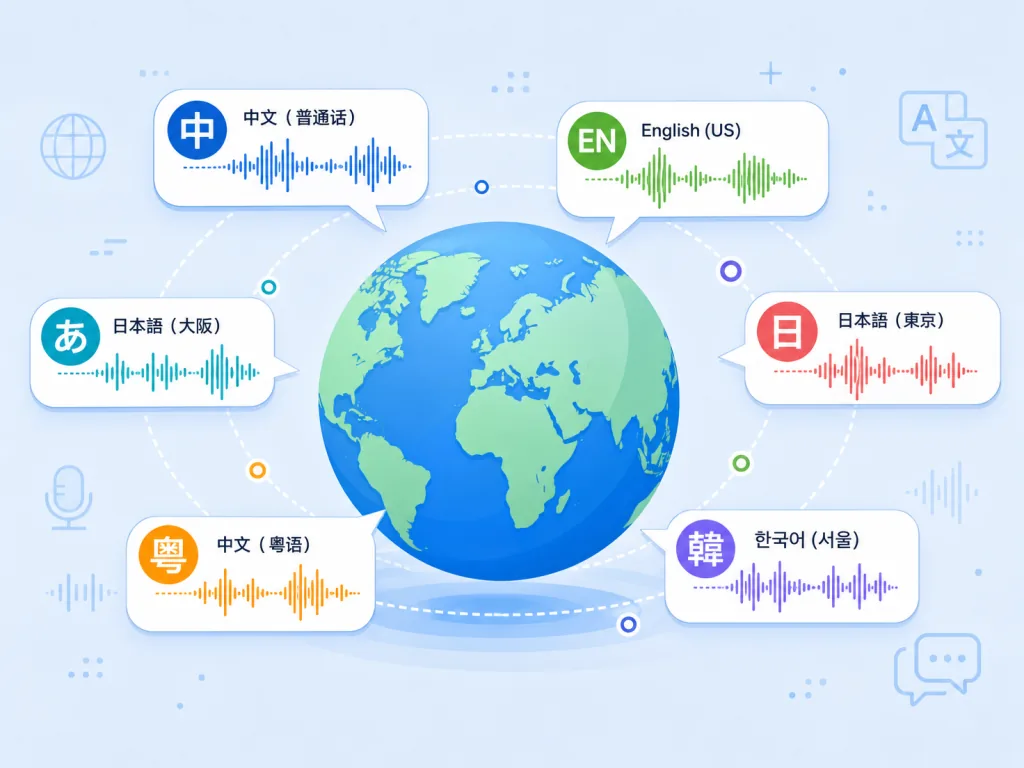
CosyVoice 3 covers Chinese, English, Japanese, Korean, German, Spanish, French, Italian and Russian in one model, plus 18+ Chinese dialects including Cantonese, Hokkien, Sichuanese, Northeastern, Shaanxi, Shanghainese, Tianjin and Shandong. With cross-lingual zero-shot cloning, a 10-second reference clip is enough to copy a voice, and the same voice can then "speak" text in a completely different language. That matters for teams building multilingual customer service or localizing audio content — previously you trained several monolingual models, now one model does the job.
2. Pronunciation correction and controllable production
Traditional TTS almost always stumbles on rare characters, proper nouns and polyphonic characters. CosyVoice 3 exposes pronunciation-patching hooks at the level of Chinese pinyin and English CMU phonemes, so you can specify the reading directly and get an accurate synthesis — no more endlessly tweaking front-end text normalization. Together with the built-in text normalization module, numbers, symbols, dates and amounts are read out the way people actually speak, which saves a lot of rule-writing.
3. Dual streaming and very low latency
For real-time conversation, CosyVoice 3 supports both streaming text input and streaming audio output, with a minimum end-to-end latency of 150ms. Combined with the Repetition Aware Sampling (RAS) strategy and KV cache optimization, long-form synthesis no longer turns into a broken record. Both acceleration paths are in place — vLLM 0.11.x+ and TensorRT-LLM — and TRT-LLM measured roughly 4x faster than HuggingFace Transformers.
4. Natural-language instruction control
You can control the style in plain language — "say it in Sichuanese", "speak faster", "sound happier", "louder" — without retraining the model. That lets PMs and ops people take part in tuning and saves a lot of labeling and fine-tuning work.
4. Technical highlights and performance
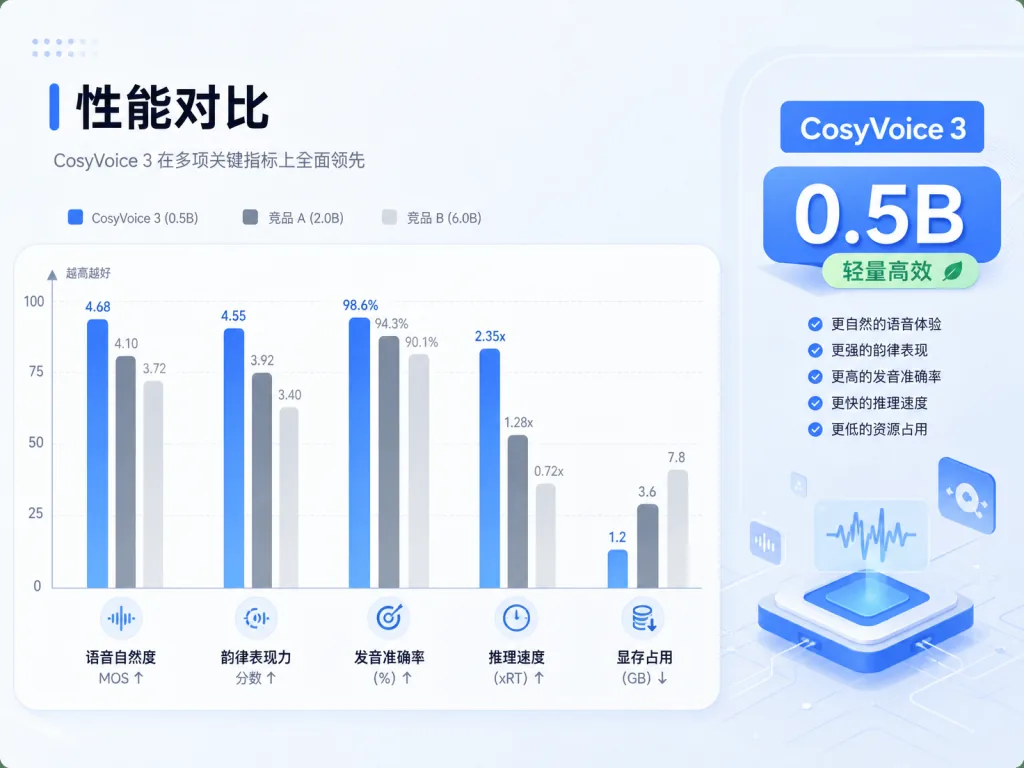
On the test-hard leaderboard in the README, the 0.5B Fun-CosyVoice3-2512_RL pushes CER down to 5.44% and SS to 75.0, overtaking the 1.5B Index-TTS2 and the 3B HiggsAudio-v2, and it is now very close to the commercial closed-source Seed-TTS (SS 77.6). On the Chinese test-zh set CER is 0.81%, even below the 1.26% human baseline. Among lightweight models, that's top-tier.
Architecturally it continues the "LLM predicts semantic tokens + Flow Matching acoustic decoding" route, with GRPO reinforcement-learning post-training on top. The engineering chain covers vLLM / TRT-LLM inference, FastAPI / gRPC serving and one-command Docker deployment, which makes production use fairly painless.
5. Who it's for
Three typical scenarios:
- Multilingual voice products: cross-border e-commerce voice support, multilingual audiobooks, voice announcements in overseas apps — one model covers every language.
- Dialects and personalized content: dialect news broadcasts, IP character cloning, automatic podcast dubbing — zero-shot cloning plus instruction control cuts production time dramatically.
- Real-time conversation and humanoid robots: streaming TTS plus low latency suits digital humans, smart cockpits and companion robots that need to listen while speaking.
It fits teams building a TTS middle layer, AI voice products, dialogue systems or multilingual localization. Pure academic research, projects with relaxed parameter budgets, or offline long-audio synthesis may be better served by 1.5B+ models.
6. Comparison
| Model | Open source | Parameters | test-hard CER ↓ | test-hard SS ↑ | Highlights |
|---|---|---|---|---|---|
| Fun-CosyVoice3-2512_RL | ✅ | 0.5B | 5.44% | 75.0 | Multilingual + dialects, 150ms streaming, RL post-training |
| CosyVoice2 | ✅ | 0.5B | 6.83% | 72.4 | Previous-generation baseline |
| F5-TTS | ✅ | 0.3B | 8.67% | 71.3 | Small, but weak on hard samples |
| Index-TTS2 | ✅ | 1.5B | 7.12% | 75.5 | Large model, close results |
| VoxCPM | ✅ | 0.5B | 8.87% | 73.0 | Lightweight, slightly weaker on hard samples |
| Seed-TTS | ❌ | - | 7.59% | 77.6 | Closed-source commercial benchmark |
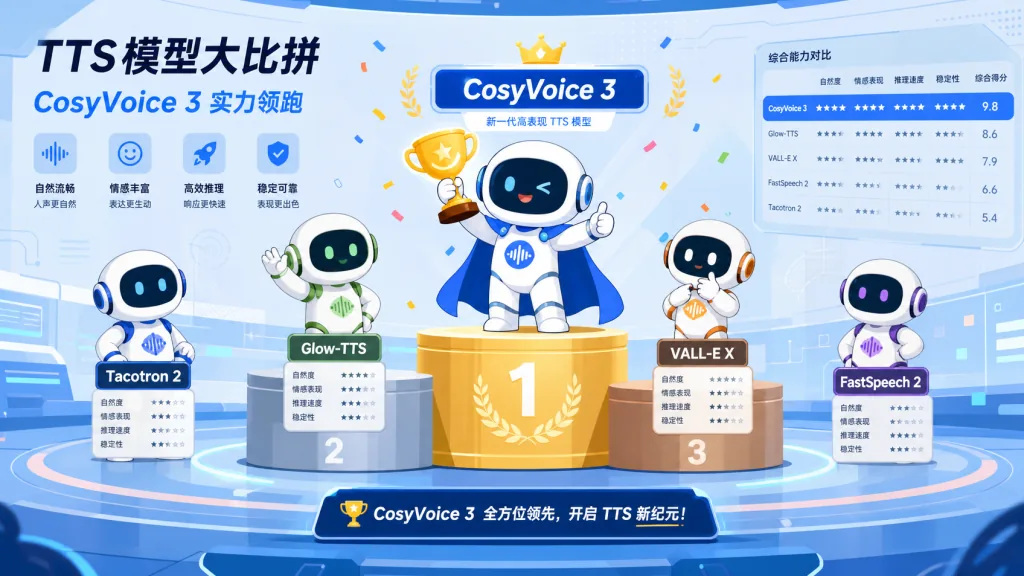
CosyVoice 3's core advantage is the combination of "0.5B size + top hard-sample performance + dialect coverage + streaming inference", which is very friendly to engineering teams with limited resources but high quality demands.
7. Getting started fast
-
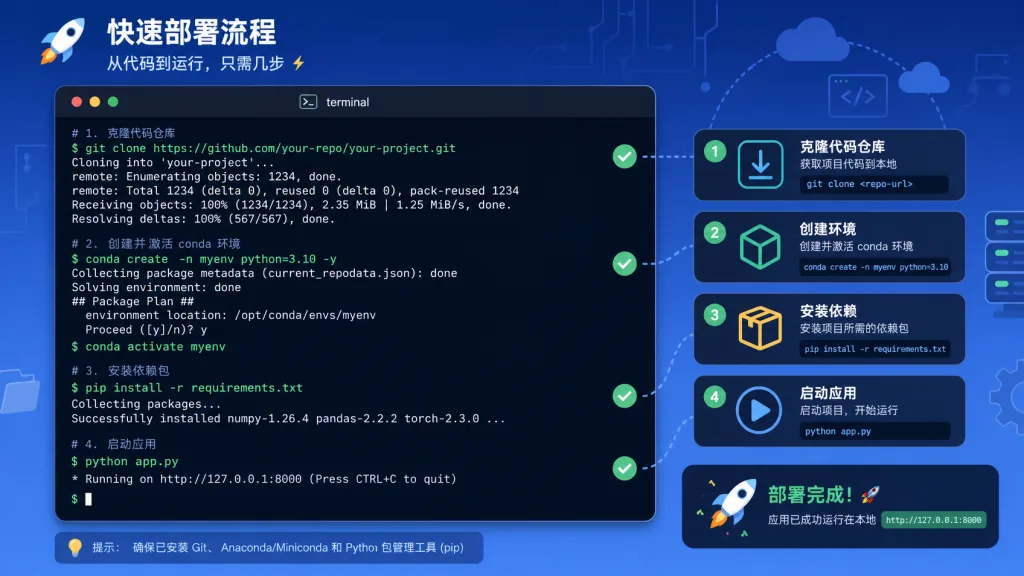
Clone and install
git clone --recursive https://github.com/FunAudioLLM/CosyVoice.git cd CosyVoice conda create -n cosyvoice -y python=3.10 conda activate cosyvoice pip install -r requirements.txt -
Download the pretrained model (Fun-CosyVoice3 shown here):
from modelscope import snapshot_download
snapshot_download('FunAudioLLM/Fun-CosyVoice3-0.5B-2512', local_dir='pretrained_models/Fun-CosyVoice3-0.5B')
Users outside China can pull the same weights with
huggingface_hub. -
Run the basic example:
python example.pylets you try all four modes — SFT, zero-shot, cross-lingual and instruction control. -
Going further: for low-latency streaming, install vLLM 0.11.0+ and run
vllm_example.py; for service deployment,runtime/pythonprovides FastAPI / gRPC Docker images; for maximum performance go Triton + TensorRT-LLM and bring it up withdocker compose up -d.
8. Wrap-up and what to do next
With 0.5B parameters, CosyVoice 3 delivers four production-grade requirements at once — multilingual, dialects, streaming and controllability — and on test-hard it even beats most 1.5B competitors. For a team that wants to build its own voice capability, it's the best value pick right now.
If you're working on multilingual customer service, dialect broadcasting or digital-human dialogue, try Fun-CosyVoice3-0.5B-2512_RL first: verify quality with example.py, then deploy to production via vLLM or TensorRT-LLM.
Related links:
- GitHub: https://github.com/FunAudioLLM/CosyVoice
- Paper: https://arxiv.org/pdf/2505.17589
- Demo: https://funaudiollm.github.io/cosyvoice3/
- Official weights are available on both ModelScope and HuggingFace model pages.
#cosyvoice #Cosyvoice #qwenaudio #TextToSpeech #SpeechRecognition #OpenSource #GitHub